
You can rent a private office in Cardiff for a defined period rather than an open-ended one, and the thing it costs you is choice of room rather than a large premium. A requirement with an end date built into it, six months for a project, nine months while a building is repaired, twelve months to find out whether a city is worth committing to, is a normal enquiry for a serviced centre and an awkward one for a landlord. The awkwardness is the whole difference.
Ask early and you usually keep the room. Ask late and you usually do not. An operator with three months of warning can solve an overrun. An operator with nine days cannot.
Most advice on flexible offices talks about contract type. That is not what a project manager is asking. The question is narrower: can I have a room from March to the end of next January, what does having a fixed end date do to what I am offered, and what happens on the day the project runs three weeks late.
Key takeaways
- Short-term means two different things. A short commitment lets you leave early. A short occupation means you are gone on a known date. Operators price them differently.
- Nothing about a short-term requirement makes it exotic. Contractors, displaced businesses, seasonal teams and out-of-area firms testing a market take rooms this way every year in Cardiff.
- A quote moves on four things: how long you are staying, how big the room is, how much fit-out and IT has to be turned around for you, and how much notice sits at the end.
- Tell the operator your end date at the enquiry stage. Hiding it costs you the room you actually wanted when you try to extend.
- Three people on site at once, or any confidential material at all, and a private room beats day passes or a serviced desk. Below that threshold, a desk is genuinely fine.
- Ask on day one what happens on the last day, because handback disputes are made in the first week, not the final one.
- A business that leaves Cardiff physically does not have to leave Cardiff commercially. The address, the mail and the phone number can carry on.
We keep private offices from 80 to 1,200 sq ft for teams of 2 to 30 at Alexandra Gate, furnished and connected, which is what makes a fixed-length requirement straightforward rather than a favour. Look at our serviced offices in Cardiff to see the range of rooms, then call 029 2089 4700 with your dates and we will tell you honestly what we can hold.
What short-term actually means, and why operators disagree about it
There are two different requirements hiding inside the phrase, and confusing them is why quotes come back that seem to answer a question nobody asked.
About being able to leave. You do not know how long you need the room. You want the right to hand it back at short notice, and you are prepared to pay something for that right.
Your end date is unknown and might be years away. This asks the operator to accept uncertainty.
About a known finish. You need the room from a start date to an end date, and on that end date you are going, because the contract has finished or the claim has settled or head office has decided.
Your end date is fixed and it is close. This asks the operator to accept a gap, possibly in November when demand is quieter.
Some centres genuinely will not take the second kind at all, which is why one enquiry gets a warm response and an identical enquiry across town gets silence.
There is a third version that gets called short-term and is not. A three-year lease with a break at eighteen months is not short-term space. It is a lease with an escape route, and it carries the survey, the solicitor and the dilapidations that a lease always carries. Our article on the difference between a flexible licence and a traditional office contract covers that distinction properly, so we will not repeat it here.
When you say six months, say whether you mean six months minimum or six months total. The answers you get will improve immediately.
What a short-term requirement is priced on
Four levers move a short-term quote, and none of them is a secret. Understanding them lets you shape the requirement into something an operator wants to say yes to.
Shorter terms carry more cost per month in every market, because the operator does the same administration, cleaning, credit checking and setup for less total occupancy. The gap between three months and twelve is usually larger than the gap between twelve and twenty-four, which means the cheapest change you can make is often adding two or three months to the end of your request.
Square footage does the obvious work, but shape matters more than people expect on short lets. A room that suits four people is easy to fill after you leave. A room that only really works for eleven is harder, which makes an operator more cautious about committing it for a fixed nine months.
A furnished room with desks, chairs, storage, broadband and telephony already in place costs the operator almost nothing to prepare. A room that needs a partition moved, extra data points, a dedicated line or furniture bought in specially does need to recover that, and on a short term there are fewer months to recover it across. Every specification you drop, you get back in the quote.
A fixed end date with nothing after it is one price. A fixed end date with the right to extend, or the right to leave early, is another, because the operator cannot confidently market the room in either case.
A quote should itemise those things separately rather than arriving as a single figure. Ask for the room, the term, what is included, what setup costs sit on top, what happens at the end, and whether anything changes on extension. Something that cannot be broken down like that is not a quote, it is a number.
Who actually takes short-term office space in Cardiff
The categories are consistent, and yours is almost certainly among them.
Engineering, construction, IT implementation, transport schemes. The end date is real and the client has already agreed to it, so the office is a cost code rather than a strategic decision.
A flood, a fire, a burst main upstairs. The business needs somewhere by Monday, the loss adjuster is involved, and the term depends on a repair schedule nobody has finalised. Ask for a room now with a review point later, not a precise end date guessed under pressure.
A contact centre doubling for a campaign, an accountancy practice staffing up to the January deadline, a retailer covering peak trading. Space needed for a known window, released afterwards.
A Bristol, Swansea or London business with enough Welsh clients to wonder. They want a real address and a real room for long enough to find out, without signing anything that survives the experiment.
The old lease ended, the new building is not ready, and there are five months in between. Businesses assume the gap will not happen until it does.
A due diligence team on an acquisition, an internal investigation, a product group whose work is not being shared yet. This one explains why a lockable private room matters more than square footage.
Four people on site full time, and a need for wall space and a large table to lay drawings out on. Their instinct was to ask for four desks. What they actually needed was a room big enough for four desks plus a working surface nobody had to clear at the end of the day, which is a different room and a different conversation. They started that conversation by describing the scheme rather than the desk count, and got a better answer for it.
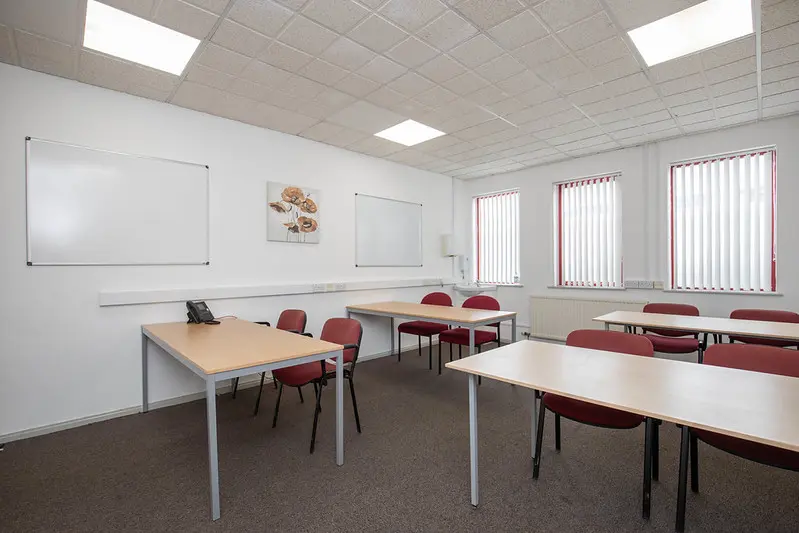
A room you can describe by its dates. Furnished and connected, so the delay is paperwork rather than building work.
How to take a room quickly
The sequence is short, and most of the delay in it is on your side rather than the operator’s. An enquiry becomes a viewing, usually within a day or two. A viewing becomes a proposal covering the room, the term and what is included. The proposal becomes an agreement, which for a serviced office is a licence rather than a lease, so there is no solicitor sitting in the middle of it. Then checks, then setup, which for a furnished room with broadband already live is measured in hours rather than weeks. Then access: fobs issued, names on the system, post redirected.
What the operator needs from you is unglamorous: your company number, your registered address, ID for a director or authorised signatory, a billing contact, the exact headcount, your start date, your end date, and a straight answer on IT. Have those ready and you compress the whole thing.
Waiting for one director to come back from holiday has delayed more moves than any other single factor.
Dedicated line or not, how many devices, VoIP handsets or softphones, and whether anything has to go into a physical cabinet.
So everyone works to the same deadline rather than a vague “as soon as possible”.
Private room, day passes or a serviced desk
Three or more people on site at the same time, or any confidential material at all, and you want a private room.
Below both of those thresholds, a desk or a day pass is the better buy and a private office is over-specified.
Two people, working on nothing sensitive, in three days a week: coworking wins, easily. It is cheaper, it needs no commitment, and the social side of a shared floor is a genuine benefit for a small team a long way from head office.
Three people upwards and the arithmetic turns. Three desks in a coworking space start to approach the cost of a small private room, and the room brings a door, a whiteboard you can leave up, storage you do not clear nightly, and the ability to hold a conversation at normal volume. Project teams talk constantly. Talking constantly on a shared floor is unpleasant for everyone in earshot and it is the main reason project teams leave coworking early.
The confidentiality threshold has nothing to do with headcount. One person handling client files, candidate data, patient information, tender pricing or acquisition documents should be behind a lockable door, full stop. A clear-desk policy on a shared floor is not the same control as a room with a fob on it, and most professional indemnity insurers and client contracts assume the second.
The exception worth naming: a team that is only in the building two days a week, whatever its size, is usually better served by desks and a booked meeting room than by a private office standing empty for three days.
When short-term is the wrong answer
Sometimes the honest advice is to stop treating your requirement as temporary, and we would rather say it than sell you the same six months three times.
The signal is repetition. You have extended twice. Each extension involved a fresh conversation, a fresh quote, a moment of genuine risk that the room was gone, and internal time from someone whose job is not property. The project keeps getting a follow-on phase. The “temporary” Cardiff presence has produced enough work that nobody is seriously discussing closing it.
At that point a rolling monthly licence on a room you simply keep costs less than repeated short terms, and it disrupts less. You stop paying the short-term loading, you stop re-negotiating, and you stop the quiet cost that nobody puts in a spreadsheet: your team not unpacking properly because they might be moving in eight weeks. Teams in genuinely temporary space behave temporarily. That is fine for four months and corrosive at eighteen.
It is also the wrong answer when the end date is not really yours to set. A business waiting on a repair schedule, a planning decision or a funding round does not have a fixed end date, it has a hope. Asking for a fixed six months in that position gets you a room you have to leave before you are ready. Ask for a rolling arrangement with a review instead, and keep the option of staying.
What goes wrong on a short let
Four of the five are prevented by a conversation in the first week. The fifth just needs planning for.
- Fixed by asking early, 4 of 5
- Plan for it instead, 1 of 5
Scroll the table → hover any row to focus it
| What goes wrong | The protection | What it costs if you miss it |
|---|---|---|
| The project overruns and the room has goneAsk early | Ask at signing what happens after your end date, then again at the two thirds point, in writing | Moving your team mid-project or splitting them across two sites |
| The notice you did not readAsk early | Read the ending clause on the day you sign, not the week you go | A missed confirmation rolls you into another period |
| IT you cannot move on timeAsk early | Order connectivity the moment the room is agreed, and ask what you can use meanwhile | A room booked for the first with a line ordered on the twenty-eighth is a room nobody can work in |
| Deposit assumptionsPlan for it | Plan on the money arriving later than the last day, and settle the final invoice separately | A project budget run to the pound with a hole in it |
| Handback surprisesAsk early | Agree in the first week what you may fix to the walls, and photograph the room on day one | The wall you drilled, the vinyl on the glass, the pallet of files nobody wanted |
“The building management team have been hugely supportive throughout our time here.”Tenant testimonial, Alexandra Gate Business Centre
“Throughout our time here” is the phrase that matters on a defined term. A short occupation is short enough that one difficult conversation in month four can spoil the whole thing.
Extending or ending cleanly
Raise both at the halfway mark, when you still have options and no urgency in your voice.
For an extension, the useful questions are: is this room available after my end date, how long can you hold it, what would the terms be, and how much notice do you need from me to confirm. Ask for the answers by email so there is a record. An operator who says the room is committed afterwards has done you a favour, because you now have months to plan rather than weeks.
For a clean exit, work backwards from your last day.
One more: tell the operator where to send anything that arrives after you leave, and for how long.
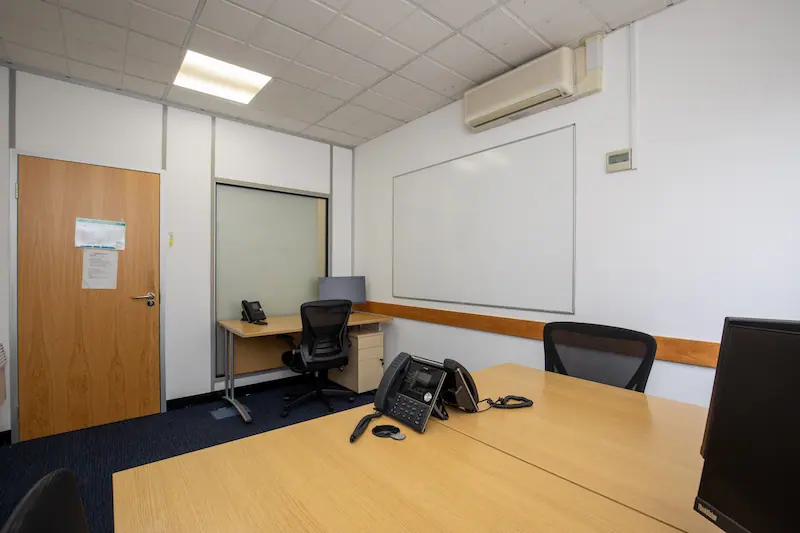
Furnished, connected, and available from a date rather than a season. Rooms from 80 to 1,200 sq ft at 2 Alexandra Gate, Ffordd Pengam.
What you can keep using after you have gone
A physical departure from Cardiff does not have to be a commercial one, and this is the part most project teams miss until the last fortnight.
The address and the mail handling can carry on after the room ends. That matters more than it sounds. A construction consultancy that spent fourteen months on a Cardiff scheme has a Cardiff track record, and the enquiries that come from it will arrive for a year or more afterwards. A business that vanishes entirely from the city loses those. A business that keeps a Cardiff address, with post still arriving at a staffed building and a room it can book when a client wants to meet, keeps competing for local work at a fraction of the cost of the office.
That is what our virtual office services in Cardiff are for: a business address and registered office address, mail handling and forwarding, and access to meeting rooms when you need to see someone here. For a team that has just spent a year in the building, it is the same address, the same reception, the same people, without the room. There is more on what a virtual office gives you month to month if you want the mechanics.
Three people, nine months, a room taken to find out whether Cardiff justified a permanent office. It did not, quite, not yet: the work was real but it was not full-time work. So the room ended and the address stayed. They still quote for Welsh contracts from a Cardiff address, they still take calls on a Cardiff number, and they book a meeting room here when a client wants to sit down. When the volume justifies desks again, they already know the building.
Setting an expectation you can actually keep
The address on your invoice is a promise about where you are, and a short let makes that promise for a fixed period only. Handle it deliberately.
Do not put a temporary address on anything permanent. Letterheads, contracts, terms of business, the website footer, your Google Business Profile and your Companies House registered office should not all be pointed at a room you are leaving in seven months, because unwinding that costs more than setting it up. Use the temporary address for the project correspondence that needs it and leave your permanent details alone.
Tell clients the truth in a single sentence, early. “We have a project office in Cardiff for the duration of the scheme, and our registered address remains the same” prevents every awkward conversation that follows from someone discovering it later. Suppliers matter here too, because a supplier who sets you up on the temporary address will still be invoicing it eighteen months on.
Then decide what the address becomes. Three options, and only three.
Redirect the post and tell everyone in writing. Clean, and the right answer when the region is genuinely finished with.
The tidy answer for anyone who wants to keep working in the region. Same address, same reception, no room.
Because you have decided to stay. A conversation to have with your operator well before the end date rather than after it.
The clients who react badly are not the ones who learn you had a temporary office. They are the ones who send something important to an address you left in March.
Three ways a defined term can end
Frequently asked questions
Can I rent an office in Cardiff for just three months?
Yes, and it is a routine request for a serviced centre, though the shortest terms carry more cost per month than longer ones. What decides it is usually the room rather than the principle: a small office that is easy to re-let afterwards is far simpler to release for a short window than a large one. Call with your dates and your headcount rather than asking in the abstract, because the honest answer depends on which rooms are free across those specific months.
What is the difference between a short-term let and a flexible contract?
A flexible contract is about your right to leave, on notice, at a time you have not yet chosen. A short-term let is about a known end date that is already in the diary. You can have both, one, or neither, and they are priced differently because they ask different things of the operator.
How quickly can a short-term office be ready?
For a furnished room in a building with fibre already installed, days rather than weeks, because the room does not need building and the connection does not need digging in. The delays are almost always paperwork and decision-making on the tenant’s side: identification for signatories, a director who is away, or an IT requirement that changes after the agreement is signed. Anything needing a new dedicated line, a partition moved or specialist furniture adds time, and that time is set by installers rather than by us.
What happens if my project runs over?
Ask early and you usually keep the room, ask late and you usually do not. Raise the possibility of an extension at the halfway point of your term, get the answer in writing, and treat “we cannot hold it past your end date” as useful information rather than a rejection, because it gives you months to plan an alternative. Operators cannot hold a room indefinitely for a maybe, but almost all of them prefer keeping a paying occupier to marketing an empty office.
Can I keep a Cardiff address after the office ends?
Yes. A virtual office keeps the business address, the registered office address, mail handling and forwarding, and access to meeting rooms, all without the room. It is the normal next step for a business whose physical requirement has finished but whose commercial interest in the region has not.
Four more things a defined term should settle
Talk to us with your dates, not your budget
The most useful first sentence you can say to any operator is the shape of the requirement: how many people, from when, until when, and what has to be in the room. We would rather tell you on the phone that we cannot hold a room across your exact months than find out together in week ten.
Independent and owner-managed since 2005, two miles east of the city centre with direct access to the A48(M) and the M4. Free on-site parking for your team and for visiting clients, which is worth more than it sounds to a project team running site visits. 24/7 fob access for the weeks when the programme demands it. Ring 029 2089 4700 with your start and end dates.
