
An office move is two jobs happening at once: getting out of the old space cleanly, and getting into the new one without losing a working day. Run in the right order, the whole thing takes around eight weeks and the only real cost is the van. Run backwards, it costs you a quarter, because the notice date slips by a week, the new line is not in, and the decision gets pushed into the next budget cycle where it quietly dies.
That second outcome is far more common than it should be, and it is almost never caused by the physical move. It is caused by a clause nobody read, a lead time nobody asked about, and an address that got changed in four places out of thirty. What follows is the running order we watch businesses work through when they move into Cardiff, written as a checklist you can actually work down.
Key takeaways
- Read the notice clause before you write the notice letter. The date notice has to land, the method it has to be sent by, and who it has to reach are all specified, and getting any of the three wrong usually costs you another full notice period.
- A week of paying for both spaces is cheaper than a rushed weekend. Overlap on purpose.
- The registered office change at Companies House goes first, because bank, insurer and payment provider updates all key off it.
- Broadband lead time sets the move date. Nothing else does. Ask for it before you commit to a Monday.
- A Royal Mail redirection is a safety net with holes in it, not a substitute for telling people your new address.
- Furnished space removes most of the physical move, which is the single biggest reason a serviced office is easier to move into than an empty unit.
- Nobody remembers a move that went well. They remember the Monday the wifi did not work, so spend your attention there.
We keep furnished offices from 80 to 1,200 sq ft for teams of 2 to 30 people at Alexandra Gate, with fibre broadband ready for instant setup, which takes most of the moving-in half of this list off your hands. Look at our serviced offices in Cardiff to see the room sizes, then call 029 2089 4700 with your target date and we will tell you what is realistic.
Read the notice clause before you write the notice letter
Find the clause, read it twice, and diary the date it produces. That single job protects more money than anything else on this page, and it takes twenty minutes.
Get any one of the three wrong and the notice usually takes effect at the next available date. On a quarterly cycle that is another three months of rent on a space you are not using.
The clause lives in different places depending on what you signed. On a licence agreement for serviced space it is usually near the front, in the section covering term and termination, and it is short. On a lease it sits further in, and there may be two separate mechanisms: the natural expiry of the term, and a break clause that lets you end it early on conditions. Break clauses carry conditions that must be satisfied for the break to work at all, commonly that the rent is paid up to date and that you give vacant possession on the break date. Miss a condition and the break fails, which means you are still in the lease and still paying.
Their notice period was three months, expiring only at the end of a quarter. They served on the second day of the month, missing the deadline by one working day, and paid a further quarter on an empty office while also paying for their new one. Nothing about the move itself went wrong. The letter was late.
Proof of delivery matters more than proof of posting. Keep the receipt, the tracking record and a copy of the letter together in one place for the length of the exit. Treat this section as the practical version: find it, diary it, send it properly, prove it arrived. With the exit date fixed, the next decision is whether the two agreements touch.
Overlap the two agreements, and pay for a week of both
Take the overlap. A week of double cost buys you a move that happens during working hours, with people who are awake, and a fallback position when something is not ready.
The alternative is the compressed weekend. You hand back on Friday, you take occupation on Saturday, and every single dependency has to land on the same two days: the van, the IT, the broadband engineer, the access fobs, the cleaners and the waste collection. One of them slipping puts you in an office on Monday with no working network and no room left to fix it.
The overlap buys you time to move in stages, which changes the character of the move completely. Non-critical items go across first: filing, stock, spare kit, the things nobody needs on a Tuesday afternoon. The new broadband gets tested properly with real traffic on it before anyone depends on it. Desks get positioned, power gets sorted, and someone finds out that the printer needs a static address while there is still time to care. It also buys you a clean run at the old space, because clearing, cleaning and making good is far easier in an empty room than around people still working.
Operators expect this request. Ask for the new agreement to start a week or two before your old one ends, and ask what the cost of those extra days actually is. It is worth raising during negotiation rather than after signing, because it is a small ask that becomes an awkward one later. Where the request is refused outright, the fallback is a partial overlap: three or four days rather than two weeks, covering the Thursday to the following Tuesday. Even that removes most of the risk.
Making good: the condition you have to hand back
Making good means returning the space to the condition the agreement requires, which is not the same as the condition you found it in. On a lease that obligation can be substantial, and it is enforced through a schedule of dilapidations: a document, usually prepared by a surveyor acting for the landlord, listing every item of disrepair, alteration and reinstatement they say you owe for.
Eight jobs on the way out of a lease. Three of them on the way out of a serviced room.
- Applies to both, 3 of 8
- Lease only, 5 of 8
Scroll the table → hover any row to focus it
| On the way out | Serviced licence | Full repairing lease |
|---|---|---|
| Remove your propertyBoth | Yes. Your kit, your files, your furniture if you brought any | Yes, and everything you installed as well |
| Leave it cleanBoth | Yes, clean and undamaged | Yes, to whatever standard the agreement specifies |
| Return fobs and keysBoth | Yes, counted against what you were issued | Yes |
| Reinstate alterationsLease only | Nothing to reinstate. The room is the operator’s | Partitions, cabling, signage and anything else you added |
| Redecorate to standardLease only | Not applicable | To an agreed standard, at your cost |
| A surveyor’s schedule of dilapidationsLease only | No surveyor, no schedule | Prepared for the landlord, listing every item they say you owe for |
| Negotiate the sum claimedLease only | Nothing to negotiate | A negotiation that can take months to close |
| Physical reinstatement worksLease only | A walkthrough and a signature | Actual building work, commonly planned a year out |
Photograph everything, twice. Once on the day you took occupation, which you may not have done and cannot now fix, and once on the day you hand back, which you absolutely can. Date-stamped photographs of every wall, floor, ceiling tile, door and window, plus a short walkthrough video, cost you an hour and settle most disputes before they start.
Where a schedule of condition was attached to your original agreement, dig it out now rather than when the claim arrives. Take meter readings on the day you leave, photograph the meters, and send the readings to the utility supplier with your closing date so the final bill is based on your consumption rather than an estimate. That difference in exit work is one of the real arguments for the licence model against a traditional leased office, and it is felt most sharply at the end rather than the beginning.
Change the registered office first, then work outwards
The registered office change goes first because it is the record everything else checks. Banks, insurers, payment providers and credit reference agencies all pull from the Companies House register, and a mismatch between what you have told them and what the register says is what triggers a verification hold at the worst possible moment.
Businesses using a Cardiff address for their registered office rather than their trading address should read the difference between a business address and a registered office address, because the two do different jobs and you may not need to change both.
Every place the address appears online
Make a list of every surface the old address is printed on and work it down in one sitting. Website footer and contact page. Google Business Profile, which also affects how you appear in local search results and map listings. Bing Places. Industry directories, chamber of commerce listings, and any trade association page. Email signatures for every member of staff, not just yours. Invoice templates in your accounting software. Quote and proposal templates. Headed paper, compliment slips and business cards. Social media profiles. Job adverts still running. Your email footer disclaimer, which on a limited company must carry the registered office.
The two most commonly missed are invoice templates and the Google Business Profile. An invoice with the old address goes out for months without anyone noticing, and a stale map listing sends visitors to a building you left.
Post redirection and what it will not catch
Set up a Royal Mail redirection as a safety net, then keep telling people your new address anyway. Royal Mail offers business redirection for fixed periods that you renew rather than an open-ended service, so it buys you a defined window to catch stragglers, not permanent cover.
- Mail addressed to a former employee you did not list
- A trading name you forgot to include on the application
- A subsidiary that was never on the list
- Anything addressed to “The Occupier”
- Unaddressed mail of any kind
- Every courier: DPD, DHL, Evri and the rest are outside the service entirely
A practical addition is to ask the incoming occupier for a forwarding arrangement, informally, for the first couple of months. Most will agree, and it catches the things a redirection structurally cannot.
Where an office has staff on site to sort incoming mail and frank outgoing post, the moving period gets noticeably easier, because someone is receiving deliveries during the hours you are still unpacking. Our note on what a business address handles month to month covers what that involves in practice.
Broadband and phones set your move date
Confirm the connectivity lead time before you confirm anything else. Everything else on this list can be compressed. A new circuit cannot, because it depends on an engineer visit and on whether the fibre is already in the building.
The gap between best and worst case here is enormous. A building with fibre already in and spare capacity can have a business connected quickly, sometimes within days, because the work is provisioning rather than construction. A building with no existing service may need a new circuit installed, and where that involves civils work, wayleaves from a landlord, or a survey before the order can even be placed, the timeline runs into weeks or months. Ofcom has repeatedly identified installation lead times as a source of complaint among business customers, and the pattern is consistent: the order goes in late, the date slips, and the business moves anyway.
Ask three questions of any building before you pick a move date. Is there already a live fibre service in the building. Is there spare capacity on it. What is the realistic date for a working connection at my desk, not a connection at the building’s front door. A furnished office with fibre broadband ready for instant setup answers all three at once.
Porting the phone number
Numbers can usually be moved, with conditions. Porting a geographic number, an 029 Cardiff number for example, is a regulated process that Ofcom oversees, and it works most cleanly when you are staying within the same area and moving to a provider that can serve it. Moving out of the area is where problems appear, because a geographic number is tied to its area code and keeping it may mean moving to a VoIP service rather than a traditional line.
Three things go wrong with porting often enough to plan around. The port date slips, and calls route to the old provider for a day or two. The port completes but inbound routing to your new system is misconfigured, so calls connect to nothing. Or the port is rejected because the details on the request do not match the losing provider’s records exactly, which is the most common failure and the most avoidable: the account name, address and account number have to match what the old provider holds, character for character.
Keep a mobile in the loop for the first fortnight. Divert the main number to a mobile from the day before the port, publish it nowhere, and take it off once you have watched real calls arrive successfully for a few days. Nobody has ever regretted this.
Furniture, IT and how little a furnished office asks you to move
Here is the part that decides whether you need a removals firm or a Transit van. Moving into an empty space means buying, delivering and building desks, chairs, storage, screens and cabling, and doing it around a lease start date. Moving into a furnished room means moving your people, your computers and your files.
The order of the physical move is straightforward. Non-essential items first, during the overlap. Then furniture, only where you are actually taking it. Then IT last, on the final evening, because it is the thing everyone needs first the next morning. Anything in a server cabinet gets photographed before a single cable is pulled, labelled at both ends, and moved by whoever normally supports it rather than by the removals crew. Data protection travels with the hardware: a machine holding personal data is not a piece of furniture, and it should not sit in an unattended van or a corridor overnight.
Old furniture is a cost, not an asset. Desks and chairs more than a few years old have no resale value, charities are selective about what they will take, and business waste has to go through a licensed waste carrier with a transfer note, which is chargeable and needs booking. Budget for a waste collection and book it before the final week, because clearance slots go quickly at month end. Anything left behind counts against you at handback.
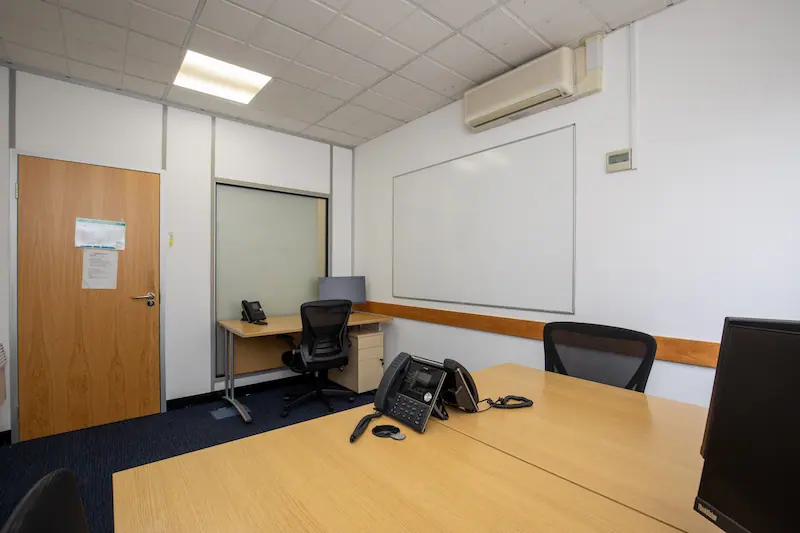
A van, a morning and a set of access fobs. Furnished offices with IT and telecoms provision and fibre ready for instant setup, so the moving-in half of this checklist collapses.
Two weeks of packing, one Friday afternoon of moving, and the only furniture that travelled was a single meeting table nobody could bear to part with. That is the genuinely commercial argument for furnished space, and it is not marketing: our furnished offices come with furniture that can include desks, chairs and storage.
Telling the team, and when
Tell staff before you tell clients, and tell them earlier than feels necessary. A move changes people’s commute, their childcare, their parking and sometimes their travel cost, and those are not small things to spring on someone with a fortnight’s warning.
Announce the decision as soon as it is genuinely made, not when it is likely. Give them the address, the travel options, the parking position and the first day, and be honest about what is not yet known. Then follow with the detail people actually ask about: where to park on day one, how access works, what to pack, what not to pack, when their machine will be unavailable, and who to contact on the first morning when something does not work.
Run a site visit before the move for anyone who wants one. It costs an hour, it removes most of the first-day anxiety, and it usually surfaces a practical problem you had not spotted, like where the deliveries actually arrive or whether the bus stop is on the right side of the road.
The eight week countdown to the first Monday
Eight weeks is enough for most moves into serviced space and tight for a fitted-out one. Here is the spine.
- Confirm the new space and sign
- Locate the notice clause and calculate the exact date notice has to land
- Confirm the connectivity lead time in writing
- Book the overlap
- Serve notice by the method the agreement specifies, by recorded delivery
- File the proof of delivery
- Tell the team
- Place the broadband and telephony orders
- Start the number port
- Book the removals firm and the waste collection
- Start the Companies House registered office change
- Update HMRC, the bank, insurers and payment providers
- Order new stationery
- Draft the client announcement
- Get a schedule of condition position on the old space
- Apply for the Royal Mail redirection
- Update the website, Google Business Profile, directories and email signatures with a live-from date
- Send the client announcement
- Start moving non-critical items during the overlap
- Test the broadband properly, with real traffic
- Confirm access, fobs and parking for day one
- Photograph the old space in full and take meter readings
- Complete the clearance and clean
- Move IT on the last evening
- Confirm the number port date
- Set up and check the network
- Check the phones
- Check the post is arriving
- Get the kettle working before anyone else arrives
What gets missed, and what it costs
Three oversights account for most of the damage, and they are not the ones people worry about.
A quarterly notice period missed by a working day is a full extra quarter on an empty space, running alongside the cost of the new one. There is no argument to be had and no goodwill to draw on, because the clause is the clause.
It lands weeks or months after you thought the move was finished. Businesses that leave a leased space without photographs, without meter readings and without reading the reinstatement obligation regularly get a claim they cannot challenge.
Almost always caused by placing the order after picking the date rather than before. Everyone in the building sees it, and the story outlives the move by years.
Behind those three sit the smaller ones: the final utility bill estimated at a wild figure because nobody took readings, the invoice template still showing the old address in November, the insurance policy that was never updated, and the Google Business Profile still pointing at a building you left in the spring.
Checking the new space is genuinely ready
Walk the space with the operator during the overlap week and test the things people will use in the first hour, not the things that look impressive.
Test the wifi from the far corner of the room rather than next to the access point, on a laptop, on a video call, with something downloading. Test a phone call in and a phone call out. Plug something into every power socket and every data point you intend to use. Check the fobs work at the doors your team will actually use, including out of hours, and at the doors you will use at seven in the morning when reception is not yet open. Find the kitchen, the bins, the toilets, the fire exits and the meeting room booking process.
Ask who your point of contact is and how you reach them on a Monday. Ask where deliveries go and who signs for them. Ask what happens if a fob stops working at six on a Friday evening. Get the answers before you need them, and get the things that matter to you written into the agreement rather than agreed verbally in a corridor. Our checklist for viewing a serviced office in Cardiff covers what to look for before you sign, and this walkthrough is its shorter sibling after you have.
“Assisting us with office moves on 3 occasions to accommodate the growth of our business.”Original CAD Solutions, tenant since 2012
Three moves in a little over a decade, none of which involved a notice clause, a surveyor or a new circuit, because all three were between rooms in the same building.
The first Monday
Arrive an hour before anyone else and work through the first hour in a fixed order.
Expect a few things to be wrong and treat that as normal rather than a failure. The measure of a good move is not that nothing goes wrong on the first morning, it is that nothing that goes wrong stops anyone working.
What a furnished room takes off the list
Frequently asked questions
How long does an office move take from start to finish?
Around eight weeks for a move into furnished serviced space, and three to six months for a move into an empty unit that needs fitting out. The constraint is rarely the physical move, which takes a day or two. It is the notice period on your current space and the lead time on connectivity at the new one, and those two run in parallel rather than one after the other.
Do I have to tell Companies House and HMRC separately when I move?
Yes. Updating the registered office at Companies House does not update your tax records, and HMRC needs telling separately for corporation tax, PAYE and VAT. Doing Companies House first is the sensible order, because banks, insurers and payment providers check the register and a mismatch causes verification delays.
How long does a Royal Mail redirection last?
Royal Mail offers redirection for fixed periods that you renew rather than indefinitely, so treat it as a defined window to catch things you missed rather than permanent cover. It also only redirects mail addressed to the names and business names you listed on the application, does not cover items addressed to “The Occupier” or unaddressed mail, and does not touch anything sent by courier. Tell people your new address properly and let the redirection catch the remainder.
Can I keep my phone number when I move office?
Usually, particularly when you are staying within the same area code. Number porting is regulated and providers are required to co-operate, but the request has to match the losing provider’s records exactly or it gets rejected. Moving out of the area with a geographic number is harder and often means switching to a VoIP service to keep it. Divert to a mobile for a fortnight either side of the port date as a backstop.
What do I need to do to the old office before I hand the keys back?
Remove everything you own, clean it, take meter readings and photograph every surface with a date stamp. On a lease, add reinstatement of any alterations you made, redecoration to whatever standard the agreement specifies, and expect a schedule of dilapidations from the landlord’s surveyor. On a serviced licence it is usually a walkthrough, the return of fobs and keys, and a signature, which is a large part of why handing back a serviced room takes days rather than months.
Four more things to settle before the van arrives
Bring the list of things that went wrong last time you moved
The half of this checklist that businesses dread, buying furniture, waiting on a circuit, chasing an engineer, is the half a furnished office removes. What remains is your notice letter, your address changes, your post and your van, and those are all things you control.
Independent and owner-managed since 2005, two miles east of the city centre with direct access to the A48(M) and the M4. Free car park, 24/7 fob access, furnished offices with IT and telecoms provision, and fibre ready for instant setup. Call 029 2089 4700 with your notice date and your target Monday, and we will tell you honestly whether it works.
