
A furnished office is a room you can work in on the day you collect the fob. Desks, chairs and storage are already in place, broadband and telephony are provisioned, and cleaning, security and reception run as part of the building instead of sitting on your to-do list. That is the promise. The word covers a wide range in practice, and the gap between two furnished offices advertised at the same size can be the difference between opening a laptop and spending three weekends with an Allen key.
This page sets out what the furnished specification covers at Alexandra Gate Business Centre, what the wider Cardiff market tends to mean by the term, and the questions worth asking on a viewing so you know exactly what arrives with the room.
- Desk and task chair
- A pedestal or drawer, sometimes
- Power for a laptop, monitor and dock
- A wired data point, or wifi
- Storage cupboard or filing cabinet
- Bin and recycling point
- Window blinds and usable wall space
- Lighting that suits your layout
Most disappointments on a viewing come from a buyer who counted the first layer and assumed the second.
Key Takeaways
- Furnished here means furniture supply that can include desks, chairs and storage, with IT and telecoms provision and professional telephony including phone and number.
- Broadband is high-speed fibre-optic and ready for instant setup, with options running from shared access up to 500 Mbps dedicated lines.
- The furniture stays ours. You licence the room and the use of its contents, you do not buy them.
- Most centres will let you bring your own desks and screens. Settle in writing where the supplied furniture goes and who moves it.
- Cat A, Cat A plus and Cat B describe how finished an empty commercial unit is. A furnished serviced office skips all three stages.
- Ask for a written inventory on day one. It protects you far more than it protects us.
- Almost every team arrives with more boxes of paper than it expected and fewer cables than it needs.
Our furnished serviced offices in Cardiff run from 80 to 1,200 sq ft for teams of 2 to 30 people, cleaned daily, covered by 24/7 fob access and CCTV, with free parking outside the door. The room you view is the room you can work in. Ring 029 2089 4700 and we will walk you through a size that fits your headcount.
What “furnished” actually means when you rent an office
Furnished means the operator supplies the working contents of the room and keeps ownership of them. You get the use of desks, chairs and storage for as long as your agreement runs, then hand them back in the condition you found them, with fair wear and tear allowed. Nothing on the inventory is yours to sell, alter or take with you.
That much holds across the serviced office market. What varies, and varies enormously, is the depth of specification sitting behind the word.
What is included as standard
Our furnished offices come with IT and telecoms provision built in. Furniture supply can include desks, chairs and storage. Telephony is professional, with phone and number provision, so a team can answer calls on a Cardiff line from its first morning rather than waiting three weeks for a provider to schedule an engineer. Broadband is high-speed fibre-optic and ready for instant setup, and the options run from shared access up to 500 Mbps dedicated lines for teams moving large files, running video edits or hosting their own kit.
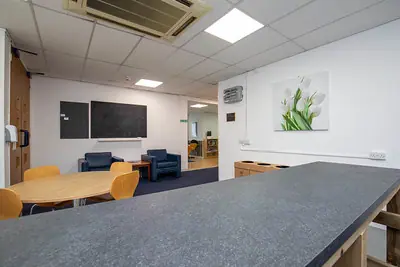
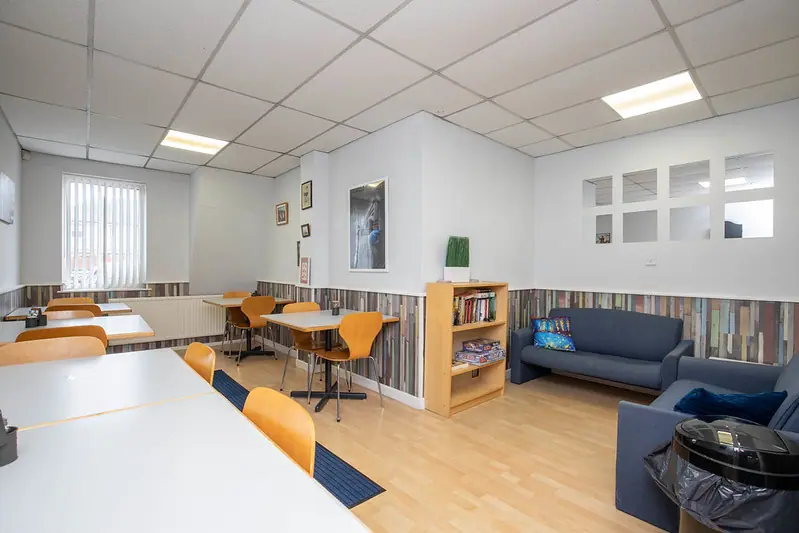
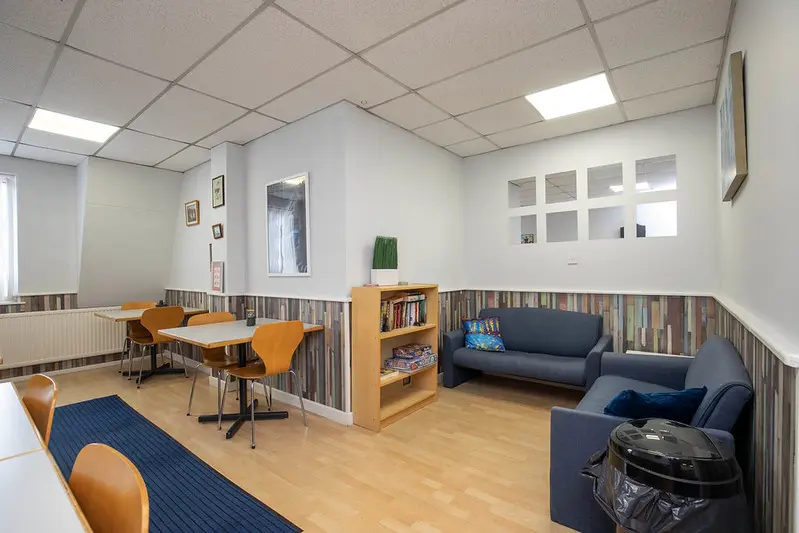
The building carries everything around the room. Daily cleaning of offices and communal areas. Free on-site car parking for staff and visitors. Fob-based access control that works 24/7, CCTV monitoring around the clock, and optional intruder alarms for individual offices where a tenant wants a second layer on the door. Reception is staffed Monday to Friday, typically 8:30am to 4:45pm, and handles the post: incoming mail sorted, outgoing mail franked. There is a cafe on site doing sourdough focaccia sandwiches and barista coffee, collaboration zones for the conversations that should not happen over someone’s desk, and natural light through the offices.
Where operators differ most is the line between “furnished” and “serviced”. A room can be furnished and still leave you buying your own connectivity, arranging your own cleaner and paying separately for a parking permit. Get the fee split before you compare two quotes side by side, because a low headline number with four extras behind it beats nothing. Our guide to what an all-inclusive office fee should cover takes that apart line by line.
What an unfurnished or Cat A space gives you instead
A Cat A commercial unit is a finished empty box. Floor, ceiling, lighting, mechanical and electrical services, and usually a basic distribution of power and data around the perimeter. No desks, no chairs, no partitions, no kitchen, no cabling to any particular workstation, and quite often no flooring finish you would want a client to walk across. It is designed to be handed over so that an incoming tenant can build whatever they want inside it.
That is a genuine option and sometimes the right one. It also means the room does nothing for you until you have spent money on it, which is the point covered further down this page.
Who owns the furniture
We do. A licence agreement gives you the right to occupy the room and use what is in it, not title to the contents. The practical consequences are small but worth knowing: you cannot drill a bracket into a supplied desk, you cannot dispose of a chair you dislike, and anything you damage beyond fair wear and tear is chargeable at the end.
The upside is that ownership never becomes your problem. No depreciation on your balance sheet, no CAPEX approval, no resale headache when a team of six becomes a team of three. Usable floor area is what you are really buying: the 80 to 1,200 sq ft range at Alexandra Gate is the room itself, and how much of it stays usable once desks, storage and circulation space are in is a question best answered standing in the doorway rather than reading a floor plan.
The furniture that comes with the room, desk by desk
Think about the specification in two layers: what sits at each person’s position, and what serves the room as a whole.
Four are standard almost everywhere. Three are worth asking for. Three are rarely included unless you say so.
- 4Standard almost everywhere
- 3Ask, and often yes
- 3Rarely included as standard
Scroll the table → hover any row to focus it
| Item | What to expect | What to ask on the viewing |
|---|---|---|
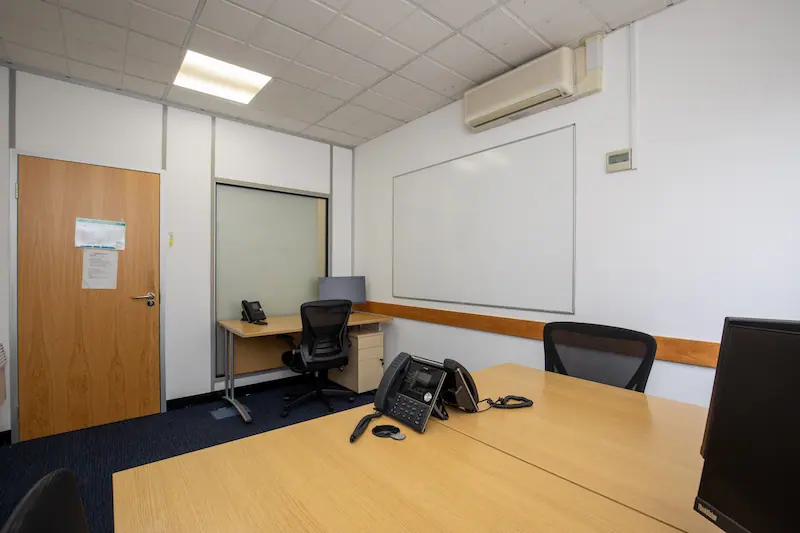
| DeskStandard | One per position, across the whole market. | How wide? A 1,200mm desk and a 1,600mm desk feel like different jobs with two monitors on them. |
| Task chairStandard | One per position, quality varies widely. | Does it adjust at seat height, back and arms? The HSE sets employer duties on display screen equipment. |
| Desk pedestalAsk | Common but not universal. | The single item most often quietly missing when a room is called fully furnished. |
| Storage cupboard or cabinetStandard | Part of the room-level specification here. | Does it lock? Paper personal data needs a lock rather than a shelf. |
| Bin and recycling pointStandard | Provided, and emptied by the daily clean. | Confirm the cleaning covers your room, not only the communal areas. |
| Window blindsAsk | Usually present, occasionally not. | Sounds trivial until a west-facing room in July makes the screens unreadable. |
| Usable wall spaceAsk | Varies with the room and what is already on it. | Are you allowed to use it, and with what fixings? |
| WhiteboardRarely standard | Possible rather than standard across the market. | Raise it before signing, while it is part of the deal. |
| Wall-mounted screenRarely standard | Possible rather than standard. | Who mounts it, and does the fixing become a making-good item? |
| Small meeting tableRarely standard | Possible rather than standard. | Or book a meeting room downstairs instead of losing floor area to it. |
Requests get handled sensibly in an owner-managed centre because there is no head office to refer them to. A team that needs an extra cabinet, a different desk arrangement or a second storage unit should raise it before signing, while it is part of the deal, rather than after, when it becomes a favour. Put whatever is agreed in the schedule attached to your licence agreement.
Take a four-person recruitment firm moving out of a converted Roath flat. They arrive expecting four desks and four chairs, which they get. What catches them out is that two of the four spend most of the day on the phone and want a proper acoustic gap between positions, and that their compliance files fill more than four pedestals. Both were solvable at the viewing stage. Neither was solvable by email in week three without moving furniture around a working office.
Power, data and where the wifi takes over
Power and data are the specification questions people forget until the first Monday. Get them settled at the viewing, because they are cheap to fix in advance and disruptive to fix afterwards.
Sockets at the desk
Count the sockets in the room and divide by the number of people you intend to seat. A modern desk position wants power for a laptop charger, a monitor, a dock and a phone charger, and that is before anyone brings a second screen or a desk lamp. Rooms fitted out years ago were built for a desktop and a phone.
The fix is usually simple, and the honest answer is that an extension lead under a desk is not it. Ask what the room has, ask whether additional sockets can be added, and ask who pays for that work.
Wired point or wifi
Both exist in most serviced offices, and they behave differently. Wifi covers the building and suits laptops, phones and anyone moving between their desk, the cafe and a meeting room. A wired data point at the desk gives a stable connection for the things that hate packet loss: video calls all day, large file transfers, VoIP handsets, a network printer.
At Alexandra Gate the fibre-optic connection is ready for instant setup, with shared access at the entry level and dedicated lines up to 500 Mbps for teams that need guaranteed bandwidth rather than a share of it. Which one you want depends on what your work does, not how many people you have. Two video editors will strain a shared connection that twenty accountants would never notice.
Adding your own switch or router
Usually yes, with a conversation first. Plenty of tenants bring their own firewall or switch because their IT policy requires it, and a dedicated line makes that straightforward. What matters is that any kit you add sits behind your own connection rather than interfering with the building’s network, and that someone knows it exists when a fault needs tracing. Agree cabling routes before anyone runs a cable across a communal corridor.
 Day one
Count the sockets before you count the desks
Fibre is live and ready for instant setup, from shared access up to a dedicated 500 Mbps line. Telephony comes with phone and number provision, so a Cardiff line answers on your first morning rather than three weeks later.
- Rooms from 80 to 1,200 sq ft, teams of 2 to 30
- Daily cleaning of offices and communal areas
- 24/7 fob access, CCTV, optional intruder alarms
- Free parking for staff and visitors
Storage: pedestals, cupboards and cabinets
Storage is the item small teams underestimate by the widest margin. A five-person professional services team generates a surprising amount of paper in twelve months even with a paperless policy, because signed documents, ID copies, contracts and the box of things nobody will decide about all end up somewhere physical.
A pedestal per desk handles personal items and current work. A filing cabinet or lockable cupboard handles the shared material that should not sit on a windowsill. Anything older than the current year is an archive problem, and archive material does not belong in a room you are paying for by the square foot, which is why offsite document storage exists and is cheap by comparison.
Lockable storage carries a second purpose beyond tidiness. Personal data kept on paper is still personal data, and the Information Commissioner’s Office expects organisations to apply appropriate security to it, which in a shared building means a lock rather than a shelf. Our private offices lock, the building runs on 24/7 fob access with CCTV, and individual intruder alarms are available where a tenant wants more.
Bringing your own desks, chairs and screens
Yes, in nearly every case, and it is more common than people assume. Teams arrive with monitors, docking stations, standing desk converters, a specific chair someone needs on medical advice, and occasionally their entire desk stock from a previous office they liked.
- Where does the supplied furniture go, since it has to live somewhere and a centre may or may not have storage capacity for a full room’s worth.
- Who moves it, and on what day, because a lift and a corridor shared with other tenants is not a Tuesday afternoon free-for-all.
- Does swapping the furniture out change anything in your licence agreement or the fee.
- Who is responsible for the supplied items while they are in storage.
Screens and monitor arms deserve a separate mention. A monitor arm clamps to a desk edge or bolts through a grommet hole, and the second of those puts a hole in furniture that is not yours. Clamp mounts are fine. Ask before you drill anything, including walls, because wall fixings become a making good item at the end.
Your logo on the door and a listing in reception
Branding a licensed room is normally allowed, within limits, and the limits are about reversibility rather than taste. Removable signage on or beside the office door, your company on the tenant listing at reception, and your own choices inside the room are the usual position in a business centre.
Permanent alterations are the ones that need permission: painting, wall graphics applied directly to plaster, anything screwed into the fabric of the building, and external signage visible from outside, which can carry planning implications the landlord rather than the tenant has to manage. A licence agreement gives you exclusive occupation of your room and quiet enjoyment of it, so what happens inside is largely yours. The building’s shared areas are a different matter, and the answer there is usually a conversation with the centre manager.
 Second week
A desk that knows your company name by the second week
Reception matters more than tenants expect. A staffed desk Monday to Friday that knows your company name, greets your clients by yours rather than the building’s, and takes a delivery when nobody is in is the difference between looking like a business and looking like someone with a mailbox.
What happens to your kit when you leave
You take what you brought, we keep what we supplied, and the room goes back roughly as you found it. That is the whole principle, and everything else is detail about where the line falls.
Handback conditions are described as dilapidations in the commercial property world, and as making good in plainer language. For a furnished serviced office the obligation is light compared with a lease, because you never altered the structure in the first place. Expect to remove your own furniture and equipment, take down signage, fill and touch up any holes you made, clear the room of rubbish and hand back every fob issued to you.
Three things to agree in writing at the start rather than argue about at the end. What the inventory says was in the room. What counts as a permitted alteration, so that a wall bracket you were told was fine does not become a charge. And who disposes of what, because the item most likely to cause a disagreement is the pile of your own furniture nobody wants to pay to take away. Your notice period sits in your agreement, and it drives the whole timetable, so read that clause on the day you sign rather than the day you decide to move.
The reverse question, how quickly you can get in rather than out, has its own answer in our guide to moving into a furnished office at short notice.
Who pays when something gets damaged
Fair wear and tear is on us. Damage is on you. The line between them is the part worth pinning down, because “fair wear and tear” is a legal phrase with a common-sense meaning: the deterioration that happens through normal use over time, not the deterioration caused by an event.
A chair’s gas lift failing after four years of daily use is wear. A castor snapping because someone stood on the seat to change a light bulb is damage. A desktop showing marks from a keyboard and a mug is wear. A cigarette burn or a gouge from a badly moved filing cabinet is damage.
Two documents settle almost every dispute before it starts. The inventory schedule, which lists what is in the room and its condition on day one, ideally with photographs taken by you as well as by us. And the damage or deposit clause in your agreement, which tells you what any security held against the room can be applied to. Read both. Photograph the room yourself on the morning you move in, keep the images, and the conversation at handback takes ten minutes.
“Interview facilities for our clients, excellent quality offices, on-site catering and plenty of parking.”Tenant testimonial, Alexandra Gate Business Centre
Specification arguments are settled by people who have sat in the rooms for years rather than by a listing. “Excellent quality offices” is the part of that sentence doing the work here.
Furnished licence or fitting out an empty unit
The comparison comes down to capital. A furnished serviced office asks for a monthly fee and gives you a working room. An empty unit asks for a fit-out before a single person sits down, and that money leaves your business months before the office produces anything.
Cat A, Cat A plus and Cat B in plain terms
The landlord’s finished shell
Raised floors or floor screed, suspended ceilings, lighting, heating and ventilation, fire detection, and basic power and data distribution. Blank, clean, and unusable as an office.
Landlord-funded fit-out
Sometimes written CAT A+. Turns the shell into a ready-to-occupy space with furniture, meeting rooms and connectivity already installed. It exists because landlords got tired of watching small tenants walk away from empty boxes.
Your own fit-out
Partitions, meeting rooms, kitchen, flooring finishes, joinery, branding, furniture, AV, cabling to each desk. Designed around your business and paid for by your business.
What the spend buys and what happens to it
Cat B work is priced per square foot and the range is wide. Cost consultancies including AECOM publish annual office fit-out cost guides, and the honest summary is that the number depends on specification more than on size. Before a contractor starts, there is design, pricing, procurement and often a landlord licence for alterations, which is weeks of work with no desks at the end of it.
The awkward part is what happens to that investment at the end of the term. Under a full repairing and insuring lease, a tenant is commonly required to strip out their own fit-out and return the space to its previous condition, so you can end up paying to install partitions and paying again to remove them. Money spent on a fit-out is money you do not get back, unless you can assign the lease to someone who wants exactly what you built.
Consider an eight-person software company weighing a small unit near Cardiff Bay against a furnished room here. The unit looks cheaper on rent alone. Add the fit-out, the cabling, the furniture, the professional fees, the business rates, the buildings insurance, the cleaning contract and the four months of paying for a space nobody can work in yet, and the comparison changes shape entirely.
We have set out the structural differences between the two arrangements in serviced office versus a traditional leased office.
When buying your own furniture actually pays
Rarely for a small team, and here is the honest case for it. Buying makes sense when you plan to be in the same space for a long time, when your work needs specialist furniture a general specification will not cover, such as lab benching, technical workstations or a studio setup, and when you have the cash to spend on assets rather than on the business.
Everything else argues the other way. Office furniture depreciates fast and the second-hand market is brutal, so a set of desks bought new for a six-person team will not return anything like what you paid when the team changes shape. Storing furniture you are not currently using costs money. Assembling, moving and eventually disposing of it costs time nobody has budgeted.
The version that catches people out is the middle path: buying “just a few” pieces to supplement a furnished room. That is usually fine, and it is worth checking it will still be fine in eighteen months when you move to a different room in the same building.
Walk into two sizes on the same visit
Swipe to compare → tap any card
 1 to 2 peopleTwo person office
Around 120 to 200 sq ft
The smallest furnished room with a door of its own, fobbed and cleaned.
View the two person office →
1 to 2 peopleTwo person office
Around 120 to 200 sq ft
The smallest furnished room with a door of its own, fobbed and cleaned.
View the two person office →
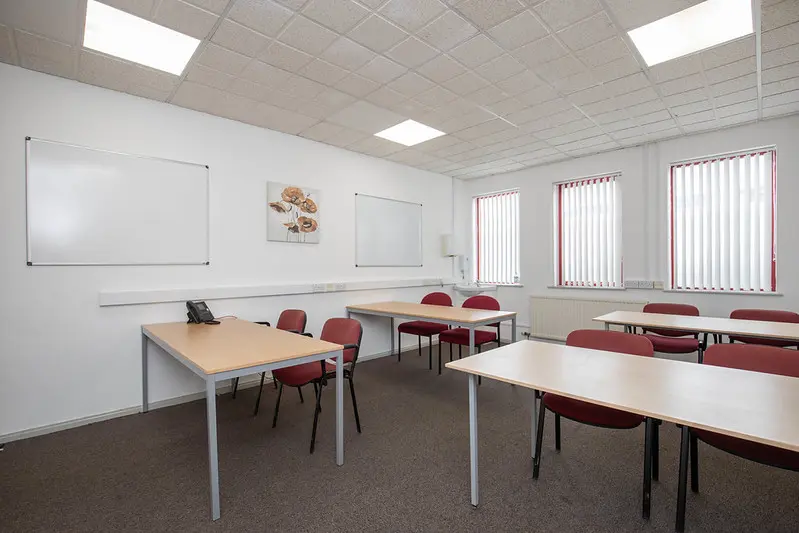 Up to 3 peopleThree person office
Around 180 to 300 sq ft
A desk each plus storage, which is where the pedestal question usually starts.
Take the three person office →
Up to 3 peopleThree person office
Around 180 to 300 sq ft
A desk each plus storage, which is where the pedestal question usually starts.
Take the three person office →
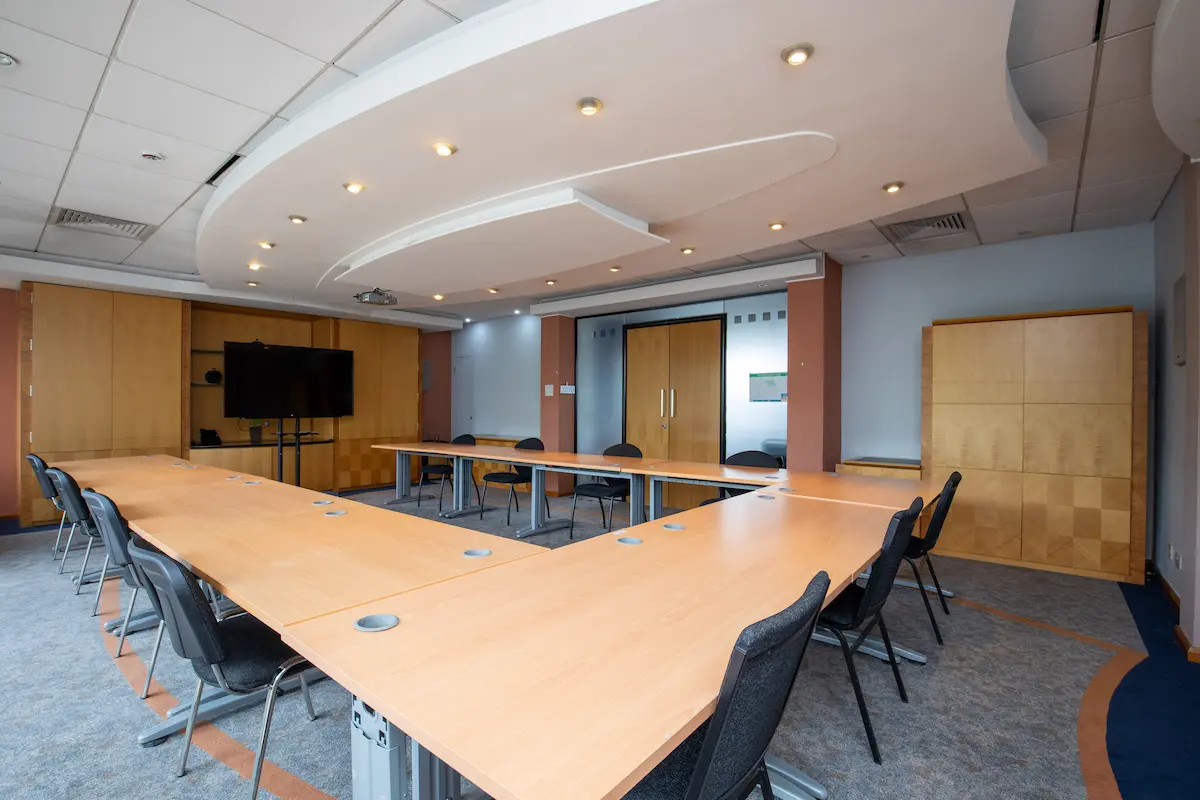 Up to 6 peopleSix person office
Around 360 to 600 sq ft
The size where socket count and acoustic gaps start to matter properly.
Compare the six person office →
Up to 6 peopleSix person office
Around 360 to 600 sq ft
The size where socket count and acoustic gaps start to matter properly.
Compare the six person office →
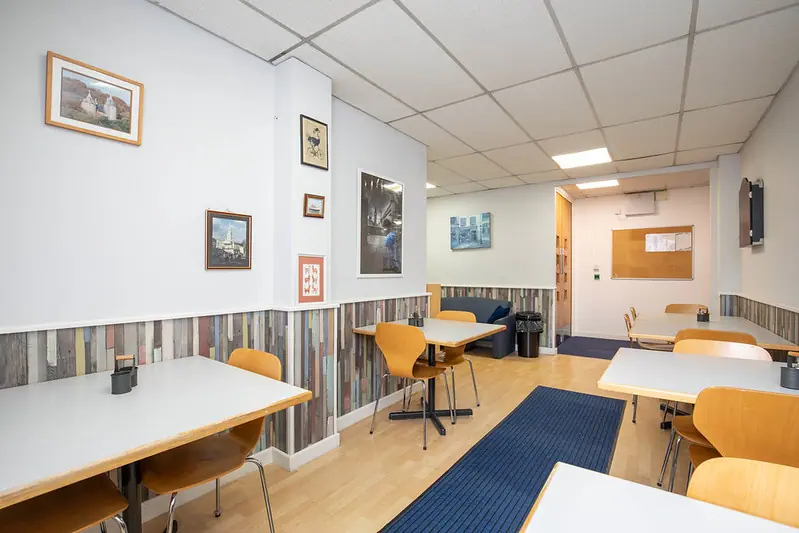 Open plan teamLarge bright office
Natural light, larger footprint
Where the room-level specification matters more than the per-desk one.
Explore the large bright office →
Open plan teamLarge bright office
Natural light, larger footprint
Where the room-level specification matters more than the per-desk one.
Explore the large bright office →
 Up to 30 peoplePremium suite
Up to around 1,200 sq ft
The top of the range, still furnished and still on a licence.
Step up to the premium suite →
Up to 30 peoplePremium suite
Up to around 1,200 sq ft
The top of the range, still furnished and still on a licence.
Step up to the premium suite →
What to bring on day one
Laptops, chargers, phones, the files you actually use, a first aid kit, and whoever owns the coffee order. Most teams arrive with too much paper and not enough cables.
What is already here: the desks and chairs, storage, the fibre connection ready for instant setup, phone and number provision, daily cleaning, a staffed reception Monday to Friday from around 8:30am to 4:45pm handling your incoming and outgoing post, free parking outside, 24/7 fob access, CCTV, collaboration zones and the cafe. You supply the work.
Come and stand in a room before you decide any of this. Our checklist for viewing a serviced office in Cardiff tells you what to look at and what to ask while you are there, and a viewing at 2 Alexandra Gate takes about half an hour. Call 029 2089 4700 to book one.
Frequently Asked Questions
Does a furnished office in Cardiff always include broadband?
No, and this is the most common assumption that costs people money. Furnished describes the contents of the room, while connectivity is a service, so plenty of furnished rooms come with an empty data socket and a phone number for a provider. Ours arrives with high-speed fibre-optic broadband ready for instant setup, with options from shared access up to 500 Mbps dedicated lines, so ask any centre you are comparing whether their broadband is included, extra, or your problem entirely.
Can I take the desks and chairs with me when I leave?
Only the ones you brought. Supplied furniture belongs to the centre and stays in the room, which is why the inventory taken at the start matters to both sides. Your own kit leaves with you, and the room is handed back clear.
How many people fit in a furnished office of 300 sq ft?
Three or four comfortably, and a fifth at a squeeze. The British Council for Offices runs a periodic occupier density study for UK workplaces, and the working figure most commercial agents quote sits at roughly 80 to 100 sq ft per workstation once circulation space, storage and a visitor chair are counted. Our offices run from 80 to 1,200 sq ft for teams of 2 to 30, and the reliable way to judge it is to walk into two sizes on the same visit and see which one your team recognises.
Am I allowed to paint the office or put up shelves?
Ask first, and expect a yes for anything reversible. Removable signage, freestanding units and clamp-mounted monitor arms are normally fine. Painting, wall graphics and anything fixed into the structure need agreement in advance, because whatever goes up has to come down at the end, and making good is your cost.
What is the difference between a furnished office and a Cat A plus space?
Very little in what you get, quite a lot in how you hold it. A Cat A plus space is a landlord-fitted unit taken on a lease, so you still carry a lease’s obligations on term, repair, insurance and rates. A furnished serviced office is taken on a licence with the services bundled into one monthly fee, which is why teams that value flexibility over control tend to end up here.
Four things to settle before the viewing
See the specification before you commit to it
Every serviced office listing in Cardiff says furnished. The word only means something once you have stood in the room, counted the sockets, opened a drawer and asked who owns the chair.
Kay will show you round and answer the awkward questions herself
Alexandra Gate Business Centre has been running as an independent, owner-managed centre since 2005 from 2 Alexandra Gate, Ffordd Pengam, Pengam Green, Cardiff CF24 2SA, two miles from the city centre with direct access to the A48(M) and the M4. Free on-site parking for your staff and your visitors, 24/7 fob access, CCTV, daily cleaning and a reception team who will know your company name by the second week.
Kay Brook, our Centre Manager, will show you around herself and answer the awkward questions about what is and is not included, because there is no head office here to refer them to.
Tell us your headcount and we will show you the size above and the size below it.
Book a viewing at Alexandra Gate
Compare the furnished suites →