
A hybrid team of ten does not need ten desks, and it does not need six either. It needs enough desks for the day when the most people turn up, which for most Cardiff teams working three days a week lands at eight. That single sentence is the whole answer, and almost every sizing mistake we see comes from a business that used its headcount or its weekly average instead.
The average day is four people out of ten. The busy day is six or seven, and the extra desks cost less than getting it wrong.
Eight desks for ten people. The ratio we would actually advise for a three day pattern with no fixed anchor days.
Stop using a ratio. The saving is one desk and the risk is a room that fails every time someone books a client meeting.
Headcount sizing is a solved problem. Attendance sizing is not, because the number that decides your office size is not how many people you employ, it is how many of them are in the building at 10am on a Wednesday. This page works through the arithmetic, tells you the ratio we would actually advise, and is honest about where that advice stops working.
Key takeaways
- Size on the busiest day of the week, never on the weekly average. The average is the number that gets teams into trouble.
- Our working ratios: about 0.7 desks per head for a two day pattern, 0.8 for three days, and effectively 1.0 for four days.
- Fixed anchor days cancel the ratio entirely. Everyone in on a Tuesday means you need desks for everyone on a Tuesday.
- Hybrid teams come in to talk to each other, so meeting and call space demand rises as desk demand falls.
- Teams under about eight people should ignore the ratios and buy a desk per head, because one person’s holiday swings the numbers too far.
- Count attendance for four weeks before you sign anything. Four weeks of real data beats any assumption.
- The car park is the constraint nobody models, and it is the one your staff will complain about first.
Our private serviced offices in Cardiff run from 80 to 1,200 sq ft for teams of 2 to 30, so you can pick a room that matches your busiest day rather than your payroll. Ring 029 2089 4700 and we will look at two sizes with you on the same visit.
What a desk ratio is, and why hybrid changed it
A desk ratio is the number of desks you provide divided by the number of people you employ. Ten desks for ten people is a ratio of 1.0. Six desks for ten people is 0.6, and it means that on any given day you expect no more than six of your ten staff to want a seat.
One desk per person was the default for decades because attendance was the default. Everyone came in five days a week, so the ratio question never arose. Office for National Statistics data on homeworking shows hybrid patterns settling into UK working life as a standing arrangement rather than a temporary one, and once part of the week is spent at home, paying for a desk that sits empty two or three days out of five stops making sense.
What a ratio of 0.6 means in practice
It means four people out of ten have nowhere to sit on a day when everyone decides to come in. That is the correct way to read a ratio: not as an efficiency figure, but as a description of who gets turned away on the worst day.
Ratios below 0.7 work in large organisations because the numbers smooth out. A company with four hundred staff can rely on the law of large numbers to keep daily attendance close to the average. A company with ten cannot, because a single project deadline pulls everyone in at once.
Who still needs a fixed desk
Some roles do, and pretending otherwise creates friction that costs more than the desk. Anyone in five days a week. Anyone with kit that does not travel, such as a designer on a colour-calibrated monitor, a bookkeeper working from physical records, or someone running a specialist machine. Anyone whose job is to be found, which usually means the office manager and whoever answers the door.
Count those people first, allocate them fixed desks, then apply a ratio to whoever is left. Applying a ratio across the whole team including the people who never leave is how you end up short.
Turning attendance days into a desk count
Busiest day: 8 desks — a ratio of 0.8
That is the number we would advise for a three day pattern with no fixed anchor days. Now look at what the week actually does, because this is the chart that explains why the average is useless.
Nobody works on an average Wednesday. Two days of the five sit above the average, and those are the days your office either works or does not. Size for the dark bars.
The correction for people who always come in
Split the team before you multiply anything. Five people in three days a week and five in five days a week is not a team on four days a week.
Permanent desks. No ratio applies, because they never leave.
Shared between them at a 0.8 ratio on a three day pattern.
Nine desks, not eight, and definitely not the seven that averaging the whole team produces.
Twelve staff on paper, but eight of them are out on site three or four days a week and only want a desk to write up reports, while four run the office five days a week and never leave it. Averaged as a single team, that looks like a seven desk business. Split properly, it is four permanent desks plus five shared between the surveyors, and the five have to be real desks rather than a corner of the meeting table, because report writing is the part of their week that needs quiet and two screens.
This is the correction that gets missed most often. When the pattern shifts and the room stops working, what to do when you outgrow your office mid-term covers the mechanics of moving up.
Size for the busiest day, not the average
The average day is a number that describes nothing that ever happens. Nobody works on an average Wednesday. They work on a specific Wednesday when the whole account team is in for a client review, and either there are enough desks or there are not.
Anchor days are the reason. Most hybrid policies name one or two days when everyone attends, and those days cluster midweek: Tuesday and Wednesday get chosen far more often than Monday or Friday. The moment a policy names an anchor day, the ratio you calculated becomes irrelevant, because attendance on that day is not a distribution, it is a mandate. Ten people with a Tuesday anchor day need ten desks on Tuesday.
That does not mean the ratio was wasted. It means you have two numbers instead of one: an anchor day requirement, which is close to headcount, and a normal day requirement, which is much lower. The design question is whether you buy desks for the anchor day or buy a smaller room and solve the anchor day another way.
All-hands days and the monthly peak
Once-a-month events do not justify permanent desks. A quarterly full team day, a monthly review, a training session, an all-staff briefing: these are meeting room and training room problems, not office sizing problems. Buying four extra desks that sit empty for three hundred days a year to cover twelve days of peak demand is the most expensive way to solve it.
Our training space handles sessions of up to 25 people, and hiring it for the day you need it costs a fraction of what four permanent desks cost over a year. That is the trade almost every hybrid team should be making.
What goes wrong when you size on the average
Two of them end up on the breakout sofa with a laptop on their knees, and one of them takes a client call from there because there is nowhere else. It happens on the Wednesday of a busy month, which is exactly the day it does most damage.
The knock-on effects are worse than the seating. People stop coming in on the days that matter, because the days that matter are the days it is impossible to work, so your anchor day quietly dissolves. The team’s most junior staff lose out first, since they are the ones who arrive last and defer to whoever is senior. Circulation space becomes storage for bags and coats. And breakout space, which exists so that two people can have a conversation without disturbing six others, gets permanently occupied by people who should be at a desk.
Oversizing has its own cost and it is more forgivable. You pay for square footage you do not use, and a room that feels empty on a Friday makes a team of nine look like a team of four to any client who visits. That is money and atmosphere. Undersizing costs you the behaviour you were trying to buy.
Our advice, stated plainly: err upwards. The marginal cost of one extra desk in a serviced office is small. The cost of a hybrid policy that fails in month three is not.
Hot desking inside a private office
Hot desking inside your own locked room is a completely different proposition from hot desking in a coworking hall, and the difference is why it works. The room is yours. Nobody outside your team sits in it, your kit stays out overnight, your whiteboard keeps yesterday’s notes, and the noise in the room is your own team’s noise rather than four strangers on sales calls.
What you give up is the assumption that a specific chair belongs to a specific person. That needs three rules, agreed once and then left alone.
Who owns which desk
Assign fixed desks to the people who are in every day and leave the rest genuinely open. Half-measures fail: a desk that is technically shared but has someone’s photo frame on it is not shared. Clear-desk at the end of the day is the rule that makes the whole arrangement work, and it takes about two weeks to become automatic.
Where people keep their things
Storage is what makes a shared desk tolerable. A locker or a lockable pedestal per person, whether or not they have a desk of their own, so nobody carries a laptop bag around all day or leaves confidential paperwork in a drawer anyone can open. Our furnished offices come with furniture supply that can include desks, chairs and storage, and the sensible move is to specify storage per head rather than per desk when the room is set up.
Two shared items solve most of the rest: a place for coats and bags near the door, and a labelled shelf for the things a team keeps in common. The practical ways small teams get more out of a room apply doubly when desks are shared.
Booking, or not
A team of ten does not need a desk booking system, and installing one is usually a sign that the room is too small rather than that the process is wrong. First come, first served works up to about a dozen people. What does need booking is the meeting room, because that is the resource hybrid teams genuinely compete over.
Hybrid teams need more meeting space, not less
People come into the office to do the things that do not work at home. That means conversations, workshops, one-to-ones, client meetings and interviews, not eight hours of quiet typing they could have done in a kitchen in Penarth. Desk demand falls under hybrid working. Meeting demand rises.
The mistake is to shrink the office and keep the same amount of meeting provision, then wonder why the anchor day feels chaotic. A ten-person team in three days a week will have more simultaneous video calls than a ten-person team in five days, because the people at home are on the other end of them. Two people on separate calls in a room of eight desks makes the room unusable for everyone else.
Calls versus meetings
They are different problems. Calls need a small enclosed space or a quiet corner, they happen unpredictably, and they last twenty minutes. Meetings need a bookable room, a table, a screen and a door, and they are in the diary.
Plan for at least one place a person can take a call away from the desks. A breakout area, a corner of a collaboration zone or a small room booked for the hour all work. Our bookable meeting rooms in Cardiff cover the diarised end of it, and the training room handles the days when the whole team plus a few clients are in.
On those two days they need close to ten seats, a room where four people can review work on a screen, and somewhere for the account manager to take a client call without an audience. On Thursday and Friday there are three of them in and the office is quiet. Sizing that agency on its average of six desks would fail twice a week. Sizing it at ten desks would waste money three days a week. The answer sits between the two, and it involves a booked room rather than more desks.
A smaller room plus meeting room hire, or a bigger room
Put the two structures side by side and the choice becomes about which failure you can live with.
Four lines favour the smaller room plus hire and four favour the bigger room. What decides it is what your team actually does when they all come in.
Scroll the table → hover any row to focus it
| Smaller room plus booked hire | Bigger room | |
|---|---|---|
| Fixed monthly costSmaller | Lower, with a variable hire cost on top | Higher, and paid every day of the month |
| Cost on quiet daysSmaller | Nothing wasted when three people are in | A third of the desks sit empty and still bill |
| When the peak is a conversationSmaller | A booked room is the right shape for a collaboration day | You bought desks for people who wanted a table |
| Starting small and testingSmaller | Lets you learn the real pattern before committing | Commits you to a shape you have not proven |
| Certainty on the anchor dayBigger | Depends on a room being free when you need it | Every desk is there. Nothing to book, nothing to fall apart |
| When the peak is desk workBigger | A boardroom is a poor place to seat four people working quietly | Everyone has a proper desk and two screens |
| Room to growBigger | A hire booking does not create a desk for a new starter | Headroom for the hires already in the pipeline |
| Predicting the invoiceBigger | Two lines to add up, and hire usage varies | One figure, the same every month |
Our position: the smaller room plus hire wins for teams whose anchor day is a collaboration day, and loses for teams whose anchor day is just a busy work day. Ask yourself what people do when they all come in. Talking to each other means book a room. Working in parallel means buy the desks.
Two practical checks before you commit to the smaller room. Ask how meeting room booking works in the building, how far ahead rooms get taken, and whether a regular slot can be held. And get the hire charge structure in writing so you can add a realistic monthly number to the smaller room’s fee and compare like with like. Our guide to what a meeting room hire in Cardiff includes covers the questions worth asking.
Is a private office worth it for a team in twice a week
Yes, for most teams, and the reason is not desks. It is everything a fixed room lets you leave in place.
Kit stays out. Monitors, a docking station, a printer, the whiteboard with the quarter’s numbers on it, the shelf of samples. Your branding is on the door. Confidential conversations happen with the door shut. Nobody outside your business overhears a salary discussion, a client name or a piece of work you have not announced. And the room is available at 7am on a Sunday if a deadline demands it, which a fixed room with 24/7 fob access supports and a managed floor with staffed opening hours may not.
Cardiff has a good coworking market, and it does a different job well. Operators including Tramshed Tech run open workspace for founders and small tech teams, and formats such as the Clockwise Club Lounge or a Clockwise Dedicated Desk suit individuals and pairs who want a professional place to work without a room of their own. Once a team reaches about six people and starts having conversations it would rather not have overheard, the maths and the manners both point back towards a lockable private office with exclusive occupation.
The interruption cost of a shared floor is the part people underestimate. Every conversation in an open space involves everyone within earshot whether they want it or not, and a hybrid team that comes in twice a week to concentrate together will get less done in a busy shared hall than it does at home.
Count your attendance properly before you sign
Start on Monday and run it for four weeks. Four weeks is enough to catch a monthly cycle and short enough that people will not give up on it.
Record one number per day: how many people were in the building. Not who was rostered, not who said they would come, not who was on the diary invite. Fob records give you the cleanest version where your current space produces them, since diary entries overstate attendance considerably.
At the end, ignore the mean. Take the highest number, then the second highest, and plan on whichever of those two you would be comfortable defending to the person who has nowhere to sit. Add one desk for growth in the next twelve months, and one more if a hire is already signed.
Then check it against the room, because desks and floor area are not the same conversation. The British Council for Offices runs a periodic occupier density study for UK workplaces, and the working figure most commercial agents quote sits at roughly 80 to 100 sq ft per workstation once circulation space is counted. Our guide to choosing an office size in Cardiff for 1 to 30 people takes the headcount route through the same question.
The anchor day problem nobody models: parking
Desks are not the only resource that peaks on a Tuesday. Parking does too, and a car park that copes easily with six people fails visibly with ten.
City centre offices push this cost onto staff, who pay for a space in a multi-storey or spend fifteen minutes circling. That is tolerable at two days a week and grating at four, and it becomes the reason people quietly stop attending on anchor days. Out-of-centre business centres solve it with their own car park, which is one of the underrated arguments for sitting two miles east of the centre rather than in it.
We have free on-site parking for staff and visitors at Alexandra Gate, and it matters most on precisely the days a hybrid team cares about. Client visits stack on the same days for the same reason, so the visitor space question and the staff space question peak together.
“Interview facilities for our clients, excellent quality offices, on-site catering and plenty of parking.”Tenant testimonial, Alexandra Gate Business Centre
Parking is the resource that peaks on exactly the same day the desks do. It is also the one nobody puts in the model, and the one staff complain about first.
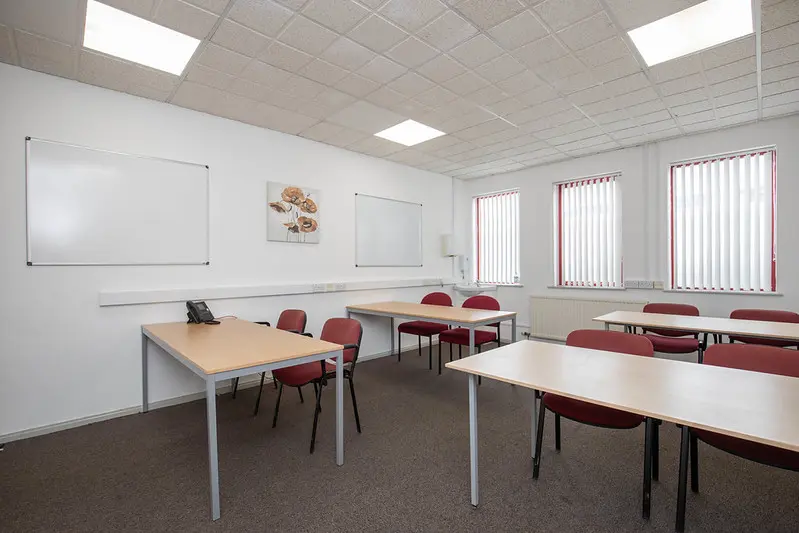
Half an hour, two room sizes. The room either looks like your Tuesday or it does not.
Which room suits a hybrid team of ten
Eight desks is the number for a ten-person team on three days a week without anchor days, and a room built for eight to ten people with space for storage and a small table is what that looks like on the floor. Two routes work here.
View both on the same visit. Half an hour walking through two sizes settles an argument that three weeks of spreadsheets will not, because the room either looks like your Tuesday or it does not.
Frequently asked questions
How many desks does a team of ten working three days a week need?
Eight, assuming attendance is spread across the week rather than concentrated. The weekly average is six, but the busiest day runs closer to eight, and the busiest day is the one that has to work. Fixed anchor days change the answer to ten.
Is one desk per person still worth paying for?
For teams in four or five days a week, yes, and the saving from a ratio at that level is not worth the disruption. For teams under about eight people it is also usually yes, because a small team’s attendance swings too widely for a ratio to hold. Ten people in two or three days a week is where a ratio genuinely starts saving money.
Can you hot desk inside a private office?
Yes, and it works better than hot desking on a shared floor, because the room stays yours. Assign fixed desks to full-time staff, leave the rest open, give everyone lockable storage whether or not they have a desk, and hold a clear-desk rule at the end of the day. A team of ten needs no booking system for desks, though it will need one for the meeting room.
Should I size my office on the average or the busiest day?
The busiest day, every time. An average is a number that describes no actual working day, and sizing to it guarantees that your most important days are the ones that fail. Take four weeks of real attendance data, use the highest or second highest daily figure, and add a desk for the growth you can already see coming.
Does a hybrid team need more meeting rooms than a full-time team?
More meeting and call space, yes, relative to its desk count. Hybrid teams come into the office to do the things that need a room and a conversation, and the colleagues who stayed at home are on the other end of the calls, so simultaneous call demand rises. A ten-person hybrid team should plan for at least one enclosed space it can use for calls and reliable access to a bookable room on its anchor days.
Four more things to settle before you sign
The number you need is not on a spreadsheet
It is the count of people standing in your office on the busiest Wednesday of the month, and the only way to know whether a room handles that is to stand in it.
Independent and owner-managed since 2005, two miles east of the city centre with direct access to the A48(M) and the M4. Free on-site parking, which matters most on the days your whole team is in. Offices from 80 to 1,200 sq ft, so you can move up a size when your attendance pattern changes. Call 029 2089 4700 to talk through your desk count with Kay Brook, our Centre Manager.
