
Office size should be chosen around how a team actually works, not around the biggest number a business hopes to reach one day. Workspace planning needs to reflect daily attendance, client visits, storage, call volume, meeting habits, and the amount of room people need to work without feeling boxed in. Cardiff businesses usually make the best choice when they pick space for the next sensible stage of growth rather than paying too much for empty desks or squeezing into a room that feels tight after the first month.
- Office size should be based on working pattern first and headcount second.
- Hybrid teams often need less permanent desk space than fully office-based teams.
- Shared meeting rooms and common facilities can reduce the amount of private office space a business needs.
- Small teams usually benefit from flexible space rather than signing for more room than they can use well.
- Growing teams should plan for the next hiring step, not the biggest long-term dream version of the business.
- Storage, equipment, phone use, and visitors all affect the right office size.
- Serviced offices in Cardiff often make sizing easier because many support spaces already exist outside the private office.
Alexandra Gate Business Centre and the office size decision
Alexandra Gate Business Centre helps Cardiff businesses choose workspace that fits real working life rather than guesswork. Managed offices, meeting rooms, and flexible business space make it easier to find the right amount of room without overcommitting too early. That matters for local teams that want a professional base, a sensible monthly cost, and space that still works when staffing, schedules, and client needs start to change.
Alexandra Gate Business Centre
Explore our serviced offices in Cardiff
Find a furnished office that suits your team size, working style, and growth plans. Whether you need a compact office for two people or a premium workspace with a manager’s room, Alexandra Gate offers practical workspace solutions with flexible terms, parking, broadband, reception support, and professional facilities.
Start here if you want to compare serviced office options in Cardiff and see which type of workspace fits your business best. This is the best route for companies that want a broader view before choosing a specific office size.
Explore Serviced OfficesIncluded facilities and amenities
- On-site parking
- Collaboration zones
- Mail handling
- Meeting rooms
- Boardroom access
- Training room
- Evening cleaning
- Furnished offices
- IT and telecoms
- Weekday reception
- CCTV and fob access
- Optional intruder alarms
- Virtual office address
- On-demand access
Ideal for two-person businesses that want a professional, private, and practical office base in Cardiff.
View Two-Person OfficeA strong fit for small teams that need a little more room for daily collaboration and client-facing work.
View Three-Person OfficeSuitable for established teams that need more workspace, better internal flow, and a dependable business setting.
View Six-Person OfficeA practical option for businesses that need a medium-sized office in Cardiff with room to operate comfortably.
View Medium-Sized OfficeBest for larger businesses that want a premium office layout with additional separation for leadership or management use.
View Premium OfficeSee what other businesses and visitors say before choosing your serviced office, meeting room, or virtual office support.
Read Google ReviewsWhy office size matters more than many businesses expect
Office size matters because the room affects how the team works every day, not just how the office looks on move-in day. Workspace pressure shows up in noise, clutter, awkward movement, poor storage, and the constant feeling that the business is working around the room instead of inside it. A space can be technically big enough and still feel wrong once calls start, visitors arrive, and everyone needs somewhere to put bags, files, screens, and spare chairs.
Cost is part of the issue, but comfort is usually the bigger one after the first few weeks. Budget pressure becomes obvious when a business takes too much space, but daily frustration becomes obvious when the office is too small. Both mistakes are expensive in different ways.
Headcount alone rarely gives the right answer. Team structure, hybrid attendance, call volume, visitor traffic, and meeting style all change how much room feels sensible. A four-person advisory firm does not use office space in the same way as a four-person recruitment team, even though the number on paper is identical.
Cardiff businesses often feel pulled in two directions during a search. Growth plans push one way, while current budget pushes the other. The best decision usually sits somewhere in the middle, with enough space to work properly now and enough flexibility to avoid another rushed move too soon.
What should Cardiff businesses measure before looking at offices?

Cardiff businesses should measure daily use before they measure floor area. Working pattern, attendance pattern, visitor flow, equipment needs, and team growth plans tell you far more than a listing that claims a room can hold a certain number of desks. A better office search starts with a clear picture of how the business operates from Monday to Friday.
Daily attendance should come first. Peak occupancy matters more than total headcount, because the room needs to work on the busiest day rather than just on the average day. A team of ten may only have six people in on most days, but if ten people arrive every Tuesday and Thursday, the office still needs to cope properly.
Meeting use should be checked next. Internal reviews, client conversations, interviews, and private calls all place pressure on a room if no separate meeting space exists. A business centre with shared meeting rooms can reduce that pressure, while a self-contained office usually needs to carry more of that activity inside its own walls.
Storage needs deserve honest treatment as well. Filing, printers, spare chairs, stationery, marketing stock, product samples, and personal items all take up room that never appears in the desk count. A room that looks generous when empty can feel cramped very quickly once basic business life moves in.
Growth planning should be realistic rather than hopeful. Sensible hiring expectations help a business choose space for the next step instead of the fantasy version of the company that may or may not exist in two years. That calmer approach usually protects both budget and morale.
Learn about the differences between a serviced office and a leased office.
Why headcount alone gives the wrong answer
Headcount gives a useful starting point, but it rarely tells the full story. Workspace needs depend on what people do, how they interact, how often they take calls, and how much room the business needs beyond the desk itself. A seven-person office can feel spacious or stressful depending on the type of work happening inside it.
Call-heavy teams need more breathing room than quieter teams. Sales staff, recruiters, advisers, and account managers usually create more movement and more sound than admin-heavy or part-time desk-based teams. That difference changes how close desks can sit without the office starting to feel tense.
Visitor flow changes the answer as well. Client meetings, interviews, deliveries, and supplier visits all put extra pressure on a room when there is nowhere else to receive people. Shared meeting space and a proper reception setup can make a smaller private office work far better than the same room would in isolation.
Equipment changes the feel of a room more than people expect. Large screens, printers, shelves, sample cases, filing cabinets, and coat storage all reduce usable working space once the office is fully set up. Desk count alone ignores those realities and often leads to undersized rooms.
Human comfort finishes the argument. People need room to stand, turn, think, speak, and work without feeling they are in each other’s lap all day. A room that only works if nobody moves very much is not the right office.
How shared facilities can reduce the size you need
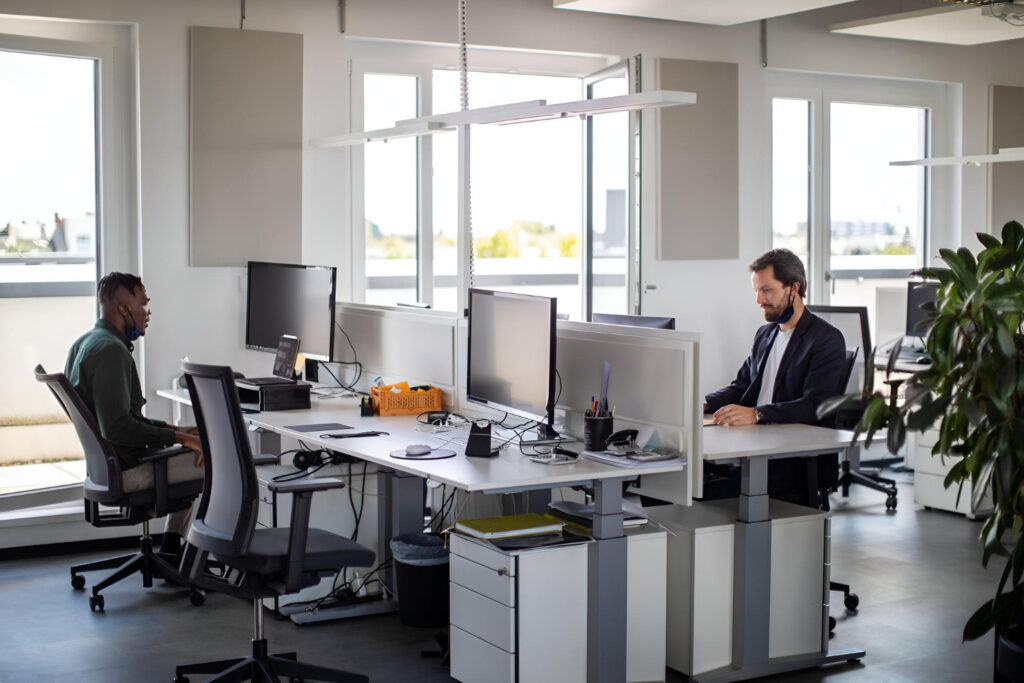
Shared facilities can reduce the amount of private office space a business needs because not every part of office life has to happen inside the main room. Meeting rooms, breakout areas, kitchens, waiting space, and reception support all take pressure off the private office when they already exist elsewhere in the building. That setup often makes a smaller room more useful than a larger self-contained office with no backup space around it.
Meeting room access is one of the biggest advantages. Client presentations, interviews, private reviews, and team catch-ups do not need to happen between the desks if a separate room is already available. That means the main office can be sized around daily work rather than occasional gatherings.
Kitchen and breakout use matters as well. Lunch breaks, quick chats, and short pauses work better when people can step outside the office rather than eating and talking over the desks. A team with somewhere else to go during the day usually needs less extra breathing space inside the private room.
Reception support can make a surprising difference to smaller teams. Visitor arrival feels calmer when guests are not walking straight into the core workspace every time the door opens. That simple change helps smaller offices stay professional and less disruptive.
Serviced office environments often make size decisions easier for exactly this reason. Shared support space means the business does not have to pay private rent for every function that only happens now and then. That can protect budget without forcing the team into a room that feels too tight.
How much office space is right for one person?
One person usually needs a compact office with enough room to work properly, store essentials, and meet the occasional visitor without the room feeling overfilled. Solo workspace should feel professional and calm rather than oversized and expensive for no clear reason. That makes a smaller private office or flexible managed space a strong fit for many one-person businesses in Cardiff.
Desk setup is the first thing to judge. Screen size, second monitor use, filing needs, printer space, and a spare chair all matter more than people expect when they first leave home working. A solo office only works well when the person using it can sit, think, take calls, and handle paperwork without constant clutter.
Client use changes the answer slightly. Advisers, consultants, brokers, and service-based professionals may want enough room for one or two guests inside the office or easy access to a meeting room nearby. That extra requirement does not always mean a much larger office, but it does mean the very smallest room may feel limiting.
Budget discipline matters here too. New office users often benefit from taking a sensible first step rather than jumping straight into more space than they can use well. A manageable room with a professional setting usually supports growth better than an empty office chosen for ego.
How much office space is right for two to three people?
Two to three people usually need a small private office with comfortable desk spacing, room for storage, and enough air around the working area to stop the space feeling piled on top of itself. Small team space should support both conversation and concentration. That balance is what makes the room usable in real life rather than simply workable on a floor plan.
Desk layout becomes important very quickly at this level. Screen depth, chair movement, cable position, and access to windows or natural light all affect how the room feels once two or three people are in it full time. A layout that looks tidy in an empty room can feel awkward after one week of normal use.
Phone use changes the size requirement as well. Sales teams, recruitment teams, and advisory businesses often need slightly more breathing room because several conversations may be happening at once. A room that works for quiet admin tasks can feel noisy and close when three people are on calls all day.
Storage needs should not be treated as an afterthought. Filing, stationery, a printer, coats, bags, and basic office supplies all need somewhere sensible to go. Those items can eat into working space very quickly in a smaller office.
Team chemistry matters more than many businesses admit. Two or three people can work brilliantly in a compact office if the room feels ordered and easy to use. The same team can feel irritable and boxed in if every chair bump and phone call becomes a shared event.
Alexandra Gate Business Centre
Need a serviced office for three people in Cardiff?
A three-person serviced office at Alexandra Gate gives your small team a private, furnished workspace with practical business support, parking, broadband, reception services, and flexible terms.
Visit the office before deciding
Best if you want to see the workspace, check access, discuss availability, and speak with the team.
Schedule a VisitCompare serviced office options
Best if you are still comparing two-person, three-person, six-person, medium-sized, or larger office space.
Explore Serviced OfficesRead what others say
Best if you want extra reassurance before choosing Alexandra Gate as your Cardiff office base.
Read Google ReviewsHow much office space is right for four to six people?
Four to six people usually need an office that goes beyond simple desk count and starts to consider movement, sound, and teamwork properly. Mid-sized team space should allow people to move without awkwardness and work without feeling that every call belongs to the whole room. That shift is where many businesses realise office size is really about experience, not just capacity.
Walkway space becomes more important at this stage. Chairs, bags, filing, spare seating, and visitors all start to affect how people move through the room once the team grows past three or four. A crowded path between desks makes an office feel smaller than it is.
Internal meetings also change the answer here. Quick reviews, one-to-ones, and private conversations start happening more often with a four-to-six-person team. Shared meeting room access can make a medium-sized office work much better because the private room does not need to do every job at once.
Growth planning usually enters the discussion at this level. A business with four or five staff often knows that one or two more hires may arrive before long. A slightly larger room or a flexible serviced setup can save the pain of moving again too soon.
Noise tolerance matters as well. Teams working closely together can enjoy the energy of a shared room, but that same closeness becomes tiring if there is no room for quiet focus or private calls. A little extra space can be worth far more than its rent difference when it helps the team work properly.
How much office space is right for seven to ten people?
Seven to ten people usually need an office that feels organised rather than simply filled. Team workspace at this level starts to behave more like a working unit than a shared room, so layout, storage, supervision, and meeting access all matter much more. That is why the right office for ten people is never just a room with ten desks in it.
Desk clusters often work better than one crowded line-up. Grouped layouts can create order and help teams work naturally without turning every conversation into a whole-room interruption. That kind of planning usually matters more than squeezing in one extra workstation.
Meeting demand often rises with team size. Managers need one-to-ones, clients may visit more often, and interviews start happening more regularly. A space that relies entirely on the desk room for all of that will feel stretched unless good meeting facilities exist nearby.
Storage pressure grows as headcount grows. Extra equipment, spare screens, files, marketing materials, samples, and staff belongings all need to live somewhere. Businesses at this level often discover that poor storage planning makes the room feel much smaller than it looked during the viewing.
Leadership visibility matters too. Team leaders often want a clear line of sight across the office without creating a cramped or watched feeling. A well-sized room supports that balance much better than an office chosen only because the number of chairs technically fits.
How much office space is right for eleven to fifteen people?
Eleven to fifteen people usually need an office that supports both collaboration and separation. Growing team space has to cope with desk work, internal discussion, private conversations, and a steady amount of movement through the day. That makes layout quality just as important as raw room size.
Department mix becomes a bigger factor at this stage. Admin staff, account handlers, managers, creatives, and call-heavy roles may all sit differently and need different levels of quiet or interaction. A single open room can still work, but it needs more thought than a smaller team office.
Breakout and meeting access become far more valuable here. Team updates, interviews, performance chats, and confidential calls all become normal parts of the week. Shared meeting rooms can make an eleven-to-fifteen-person office work well without forcing the private room to absorb every activity.
Comfort starts to affect retention as well as productivity. Staff in growing teams notice when a workplace feels tight, noisy, or difficult to move around. A business may save money on rent in the short term, but daily frustration can quietly shape morale.
Forward planning becomes essential at this point. An eleven-person team choosing an office should not pretend it will still look exactly the same in twelve months. A room that only works at today’s headcount may stop working much sooner than expected.
How much office space is right for sixteen to twenty people?
Sixteen to twenty people usually need space that feels like an organised office environment rather than a larger version of a small team room. Operational flow matters much more once a team reaches this level. That means circulation, quiet space, storage, supervision, and meeting access all need real thought.
Desk density becomes risky if the business focuses only on getting everyone into one room. Tight layouts can raise noise levels, reduce concentration, and make the office feel stressful even when the square footage looked fine on paper. A better result usually comes from choosing a room with some margin or using a layout supported by nearby shared facilities.
Private conversation space often becomes important here. Performance chats, client calls, recruitment discussions, and sensitive issues need somewhere sensible to happen. Businesses that ignore that need often end up having half-private conversations at desks or in corridors.
Equipment and storage tend to expand with the team. Printers, filing, supplies, spare chairs, and marketing materials can all creep in unless the office has a clear plan for where those items belong. Small clutter problems become much more noticeable in a larger group.
Flexibility matters more once teams reach this size. A business with sixteen to twenty people often has departments growing at different speeds, not one flat headcount line. Managed office space can help because scaling up does not always have to mean starting the whole office search again.
How much office space is right for twenty-one to thirty people?
Twenty-one to thirty people usually need space planned around zones rather than simple desk rows. Larger team offices work best when different activities have somewhere appropriate to happen. That may still be one large office in some settings, but it often works better as a mix of private office space, meeting access, and support facilities that take pressure off the main room.
Team structure matters more than headcount at this level. Department splits, leadership presence, meeting frequency, client traffic, and the mix between quiet work and collaborative work all shape the right answer. A twenty-five-person professional services team may need something very different from a twenty-five-person sales-led team.
Circulation and acoustics become serious issues here. Crowded walkways, constant interruptions, and no clear separation between activities can make even a decent-sized office feel chaotic. Businesses at this size often get better results when they plan the room around flow rather than around maximum desk numbers.
Growth pressure deserves honest treatment. A twenty-four-person business may soon become a thirty-person business, or it may soon separate into functions with different room needs. Flexible serviced space can help because the office decision does not have to lock the company into one rigid shape too early.
Professional presentation matters more at this size too. Larger teams often host more visitors, interviews, supplier meetings, and internal reviews. A business centre with access to proper meeting space can stop the main office from becoming a catch-all environment that tries to do everything badly.
How does hybrid working change the right office size?
Hybrid working changes the right office size because total headcount is no longer the same as daily attendance for many businesses. Attendance pattern analysis often shows that the business needs less permanent desk space than first assumed. That does not always mean choosing the smallest possible office, but it does mean using real attendance data instead of instinct.
Peak days matter more than average days. A team that averages eight people in the office may still have thirteen people in on a Tuesday and only five on a Friday. The room needs to cope comfortably on the busy day, not just look efficient on paper.
Desk sharing can help, but only when the culture genuinely supports it. Flexible attendance, remote days, and role-based movement can reduce permanent desk needs if the team accepts that way of working. A desk-sharing plan that exists only in theory usually breaks down once habits settle in.
Meeting demand often rises in hybrid teams. Staff coming in fewer days a week often spend more of that time collaborating, reviewing work, and meeting face to face. That can reduce the need for rows of assigned desks while increasing the value of good meeting room access.
Human behaviour should guide the decision here, not optimism. Businesses often understate how many people prefer the same in-office days or how much room people still want once they are in. A hybrid model can reduce space needs, but it still has to feel comfortable when real life happens.
How do visitors, storage, and equipment change the answer?
Visitors, storage, and equipment change the answer because they all compete with desk space in ways that businesses often ignore until move-in day. Practical office life includes much more than people sitting in chairs. That reality is why a room that looked generous during a viewing can feel surprisingly tight once the business is fully operating.
Storage requirements vary widely by sector. Accountancy firms may keep files, trades businesses may hold samples, and training companies may need materials that never appear on the original desk plan. Those needs all reduce the amount of open working area unless the office has proper built-in solutions.
Equipment changes the feel of a room very quickly. Printers, shredders, extra monitors, whiteboards, charging stations, shelving, and router or server needs can all eat into layout flexibility. Businesses should decide where those items go before convincing themselves the office is large enough.
Visitor flow deserves equal attention. Clients, candidates, couriers, suppliers, and interviewees all affect how a space works during the week. A private office that also acts as reception, waiting area, and meeting room will feel much smaller than its desk count suggests.
Professional appearance depends on how these extras are handled. Offices feel larger and calmer when storage has been planned, equipment has a home, and visitors do not disrupt the whole room every time they arrive. That is one reason serviced business centres often feel easier to work in than their private room size alone might suggest.
What are the signs an office is too small?
An office that is too small usually creates friction long before it creates a crisis. Workspace pressure shows up in noise, clutter, awkward movement, poor storage, and the constant feeling that the team is interrupting itself. Those problems may sound minor, but they repeat every day.
Productivity often drops in subtle ways first. Staff lose focus more easily, calls distract everyone, chairs scrape past each other, and quick chats turn into whole-room interruptions. The business may still cope, but the room is now working against the team instead of supporting it.
Morale can take a hit as well. Staff notice when there is nowhere quiet for a call, nowhere sensible for a visitor, and nowhere to store basic office items without cluttering the floor. A workplace that feels too tight can make a business look as if it has outgrown its own decisions.
Growth becomes harder in an undersized office. One extra hire can feel like a major disruption, and one extra cabinet can feel impossible to place. Businesses often discover that the cheaper room was only cheaper because it delayed the real problem for a few months.
What are the signs an office is too big?
An office that is too big usually wastes money first and weakens team energy second. Empty workspace can look impressive on viewing day, but it often feels flat and inefficient once the business starts paying for unused desks and underused floor area every month. That gap between image and value is where oversized offices lose their appeal.
Cash flow carries the obvious cost. Rent, rates, utilities, cleaning, furniture, and general running costs all rise when the business takes more room than it needs. That extra spend can limit investment in better uses such as hiring, marketing, systems, or service delivery.
Atmosphere can change as well. Teams sometimes feel less connected in offices that are visibly too large for the current headcount. Empty desk banks and underused corners can make the workplace feel quieter and less focused than intended.
Planning can become lazy in oversized space. Businesses with too much room often postpone sensible decisions about layout, storage, hybrid patterns, and team structure because the office absorbs the problem for a while. Smaller, well-chosen space usually creates better habits because the room still has to earn its cost.
What should you test on an office viewing?
An office viewing should be used to test how the room will work on a normal Tuesday, not just whether it looks good for ten minutes. Practical checking reveals much more than broad floor area claims ever will. That means businesses should walk the space with desks, storage, people movement, calls, and visitors in mind.
Desk layout should be tested honestly. Screen depth, chair movement, plug access, window position, and the path between workstations all matter once the room is full. An office can look open when empty and feel awkward once real furniture goes in.
Storage space should be counted properly. Filing, stationery, printers, coat storage, kitchen bits, supplies, and personal items all need somewhere sensible to live. Businesses that skip that check often discover that the last usable wall disappears the moment cupboards arrive.
Noise and privacy should be judged on the viewing as well. Door position, shared corridor activity, window exposure, and access to nearby meeting rooms all affect how workable the office will feel. A quiet-looking room can behave very differently once the building is fully in use.
Future fit should finish the exercise. Office choice should reflect the next stage of the business, not just the current week. A good viewing ends with a clear answer to one question: will this room still feel sensible after the next hiring step?
When is flexible serviced space the smarter choice?
Flexible serviced space is the smarter choice when the business wants a professional office without taking on a long list of property problems at the same time. Managed workspace is especially useful when headcount may change, move-in speed matters, or shared facilities can reduce the need for a much larger private room. That is why serviced offices often suit teams from one person up to thirty people more often than many businesses expect.
Uncertain growth is one of the clearest reasons to stay flexible. Businesses hiring steadily, testing a new market, or still settling into hybrid routines often benefit from space that can be reviewed and adjusted more easily. A rigid lease can feel heavy during that kind of stage.
Early cost control is another strong reason. Smaller deposits, less setup spending, and access to shared facilities can make a managed office more practical than a larger self-contained option that demands more cash upfront. That matters for businesses that want a Cardiff base without putting too much capital into premises.
Operational simplicity often seals the decision. Meeting rooms, kitchens, reception flow, and building management already sitting in place make life easier for teams that want to focus on business rather than office logistics. That advantage becomes more valuable once the company gets busy.
How Alexandra Gate helps Cardiff businesses choose the right size
Alexandra Gate helps Cardiff businesses choose the right size by focusing on working reality rather than sales talk. Managed offices, meeting rooms, and supporting business facilities make it easier to match private office space to what the team actually needs. That approach reduces the risk of paying for too much room or signing for a space that feels tight too soon.
Flexibility is a big part of that value. Businesses with changing headcount, hybrid attendance, or a growing South Wales client base often need space that feels professional now without forcing a heavy long-term commitment too early. A serviced business centre can support that stage much more comfortably than a blank traditional office.
Shared facilities improve the sizing decision as well. Meeting rooms, breakout areas, and a managed environment mean the private office does not have to carry every part of the business on its own. That often makes the right room smaller, smarter, and better value than expected.
Local businesses usually benefit most from that mix of professionalism and practicality. Cardiff companies do not always need the biggest office in the building. Cardiff companies usually need the office that lets the team work well, welcome visitors properly, and grow without unnecessary drag.
Choosing an office that still works six months later
The best office size is usually the one that suits the current team properly and still gives the business a little room to breathe. Honest planning leads to better office decisions than optimistic guesswork or fear of missing out on future growth. That is why the right office rarely feels either cramped or empty. It feels usable from day one and sensible for the next stage.
Business owners do not need to predict every future detail before moving. Workspace decisions work best when they reflect real attendance, real working habits, and realistic growth expectations for the coming year. That kind of thinking usually leads to a calmer decision and a better use of budget.
Cardiff teams from one to thirty people often get the strongest result when they choose space around how work actually happens, not around how an empty room looks during a viewing. Shared facilities, meeting habits, storage, visitor flow, and hybrid patterns all deserve a place in the decision. Alexandra Gate Business Centre fits that need well because the office choice becomes about what supports the business best, not about taking on more space than the business truly needs.
